
After a deputy is wounded and two found dead in a Union City eviction standoff, landlords are reminded of the dangers in heated conflicts.

According to police, Michael Dorthick and Lizette Chan were found dead in an apparent murder-suicide on January 24 after deputies were serving what they thought to be a routine eviction.

“Some have been there two or three years, not paying rent. Now you’re telling them to leave.”
That is the quote from Union City Councilmember Jaime Patino on the increasing number of evictions and the inherent dangers of pressure-cooked situations when a conflict in a rental relationship reaches a boiling point.
The calm streets of Union City recently erupted in a hail of gunfire as the civil division of the Alameda County Sheriff’s Office was carrying out a routine eviction for nonpayment of rent. One deputy was struck in the arm and fortunately is expected to recover. After an intense standoff, the suspects were discovered deceased with wounds pointing to a murder-suicide.
Our paramount takeaway: Safety first
We have often said that whenever there is anger, crime, and violence in society, it will inevitably spill into rental units. Housing providers need to be careful when addressing any dysfunction that occurs. We have seen too many instances of physical altercations between tenants and landlords, even cases of arson.
Whenever there is acrimony in the rental relationship, our office can help resolve problems through a carefully choreographed legal process. Property owners understandably want to have some control over the buildings they own, but this should not be at the risk of personal safety.
Recently, for example, we dealt with a situation in a mixed-use building with residential above and commercial below. When the residential tenant flooded a bathroom, water intruded on the consignment clothing shop below.
The angry merchant called the landlord to report water was pouring down upon their business. In turn, the towering owner showed up at the residence by going up the stairs and holding a female tenant by the arm to give her a scolding about flooding the bathroom. The boyfriend took exception to this and a fight ensued. Fortunately, there were no weapons involved.
Bornstein Law has an uncompromising policy of serving a 3-day Quit Notice whenever a tenant lays hands on another resident; housing providers must protect the safety of renters who live in their community and whenever there is violence, threats of violence, or brandished weapons, residents generally should not be afforded the opportunity to cure the behavior because it poses a foreseeable risk.
However, we can say the same thing to landlords and property managers. It is never acceptable to physically accost someone, whether it is the owner or the tenant.
Gaining entry to the rental unit
We have always said that property owners must be the eyes and ears of their properties, but some caution should be exercised. While owners have the right, with proper notice and a permissible purpose to enter the premises, they have to be mindful of the danger that may await.
In rental units where there is disarray, damage, or illegal activity, our hard-won experience has shown us that tenants will go to great lengths to disallow the landlord to set foot on the premises.
Indeed, we have seen instances when there is a bed bug infestation and the residents will not allow an exterminator into the unit to remediate the problem because the goal is to conceal what is going on inside.
Some tenants are adamant about not allowing prying eyes to see what is transpiring in their abode and will use every excuse and stalling tactic to avoid detection of what is going on.
Whenever there is a safety concern when an uncooperative or hostile tenant is served a 24-hour notice for the landlord to enter the premises, we advise our clients to contact our office.
Normally, if the tenant obstructs entry when the landlord has a legitimate purpose, it is a “ just cause” for eviction. Although technically, the owner can use their own keys to enter the rental unit, it may be more prudent to avail the eviction process than to show up in an unannounced, heated moment
Are people living out of a commercial property?
The facts are unclear, but there is some speculation in the Union City tragedy, a pair of individuals were living out of a space zoned for business use in an industrial complex. This is a cardinal sin and whenever it is discovered that people are improvising and setting up makeshift living quarters in a commercial space, the owner has to put a stop to it.
Courts and Sheriffs are overworked so patience is in order.
Although there have been some t»weaks in some locales, the statewide eviction process fundamentally remains unchanged. We’ve outlined it here:
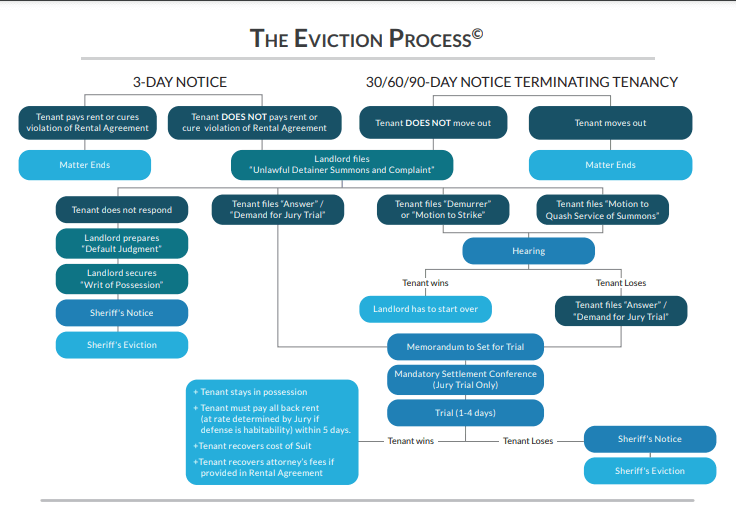
Yet the courts have faced a deluge of eviction cases in Alameda County. The courthouse staff is overwhelmed and tired, leading to delays. Even when our office obtains a judgment, the Sherrif Department does not always have the bandwidth to timely effectuate a lock-out. We can potentially wait several weeks before the tenant is physically removed from the premises, and Bornstein Law has no influence on the time frame.
Ideally, the case is settled and we do not need to take the drastic measure of having the Sheriff uproot the tenant. 90% of cases are settled, and our strong preference is to come up with a mutually agreeable solution to mend the rental relationship or part ways.
Parting thought
While we want to have a frank conversation with tenants, we do not want it to escalate to the point of violence. We would much rather that disputes be resolved early on and not let them fester. As the firm built for rental property owners, Bornstein Law can help you resolve landlord-tenant conflicts most painlessly with the least residue.
Of course, if there are any acts of violence or threats of violence, we can take action to remove the bad actor.