
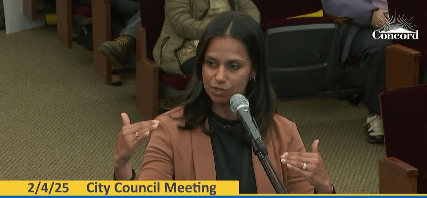
Property owners and real estate professionals were well represented in a packed City Hall chambers on February 4 to discuss changes to Concord’s Residential Tenant Protection Program that went into effect on April 19, 2024.
The agenda of the meeting was twofold: 1) if and how the city’s regulatory regime should apply to single-family homes and condominiums, and 2) whether or not to tweak the current formula used in calculating allowable annual rent increases.
It’s instructive to look at what the law is at this snapshot in time.
Single Family Homes & Condominiums
Currently, rented single-family homes and condominiums are not subject to the rent stabilization aspect of Concord’s program, meaning they are not constrained by the city's rent cap limitations. Owners of single-family homes and condos, however, must comply with rental registration requirements and pay an annual rent registry fee of $29 per unit. Moreover, minimal lease terms must be given to tenants and they can only be evicted for a valid legal reason (just cause).
Where it gets interesting is with no-fault evictions. In these types of evictions, tenants are entitled to relocation payments of two months of tenant’s rent and an ADDITIONAL moving stipend of $2,000.
In the case of an owner move-in eviction (OMI), the owner must move in within 90 days of the vacancy and occupy it as their primary residence for 24 consecutive months thereafter. If a tenant is transitioned out of the unit through an Ellis Act, the owner must record a notice that removes the unit from the rental market for 10 years. Finally, if a tenant is displaced through a no-fault eviction and the owner later returns the unit as available, the tenant retains the right to return at the terms that were in effect at the time of the vacancy.
Rent increase caps
Under the ordinance, rent increases are limited to 3% or 60% of the Consumer Price Index (CPI), whichever is lower. Hence, through July 31, 2025, the rent cap is calculated at 2.52%.
If Concord lawmakers continue to use this formula, the rent cap will be reduced slightly to 2.25% for the period of August 1, 2025 - July 31, 2026. Housing providers make a cogent argument that this paltry amount is not enough to make a profit. Several owners who attended the public meeting complained that they are struggling to make ends meet with the rising costs of doing business, if not hemorrhaging money because of tenants causing damage to the property.

Questions before lawmakers as they revisit these topics on February 25

Broadening housing stock subject to rent control: Should the full Concord Residential Tenant Protection Program apply to rented single-family residences and condominiums? The answer should be an emphatic NO.
Rent cap changes: Should there be a modification to how much landlords can raise rents? The answer should be an emphatic YES. Under state law, maximum rent increases are set at 5% plus CPI, whichever is lower. Using today’s calculus, it is 8.8%. An aberrant Concord City Council should be aligned with the more balanced state legislation.
Parting thoughts
It’s worth noting that while owners of multifamily buildings are required to fulfill their obligations under the city’s rent registry requirements and divulge details about their rental business by February 28, owners of single-family homes and condos have bought themselves some time. They will not have to register until further guidance is provided and presumably, that guidance will be shaped in the City Council’s next meeting on February 25.
A special thanks to our friends at the East Bay Rental Housing Association and other industry partners for their advocacy, as well as the many property owners and real estate practitioners who have provided a counternarrative to bad policies that stifle the production of sorely needed housing. We trust that the momentum will continue as we show strength in numbers.
Of course, Bornstein Law, in concert with our industry partners, will keep you abreast of any developments.