

Why ‘No Evictions Found’ Doesn’t Mean What You Think in California
Most eviction filings never show up in public court searches anymore, meaning housing providers are not privy to a prospective tenant’s eviction history. Housing providers blinded to a tenant’s eviction history can still use some old-fashioned personal sleuthing to identify rental risks.

We have said many times and in many venues that the greatest predictor of dysfunction is prior dysfunction. Conversely, the greatest predictor of a tenant becoming a positive member of a healthy, safe, and harmonious rental community is a prior history of being a stellar tenant.
The key difference lies in responsibility, respect for property and neighboring residents, and ease of communication. Yet many housing providers falsely believe eviction filings are within the public domain and are fair game during tenant screening. A 2017 law has quietly upended that assumption.
As we first announced after it sailed through the California Legislature and was signed into law by Governor Newsom, Assembly Bill 2819 (AB 2819) changed how limited unlawful detainer (eviction) court records are handled in California. The overarching goal was to better protect tenants with an eviction on their record, a stain that can preclude them from future housing.
The law took effect January 1, 2017, and is codified mainly in California Code of Civil Procedure § 1161.2. [Section 1167.1 applies only to timely filing of the proof of service or resulting dismissal of the case. It’s not really relevant to this discussion.]
Key change under AB 2819: Eviction case records remain sealed by default
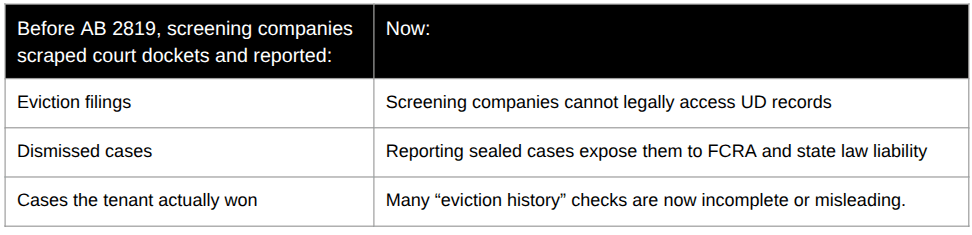
Before AB 2819, limited-jurisdiction unlawful detainer (eviction) case records were sealed for the first 60 days after filing and generally became public unless the tenant prevailed within 60 days. Under AB 2819, those records remain sealed indefinitely unless certain conditions are met:
-
The landlord (plaintiff) wins the case within 60 days of filing, or
-
If the case extends beyond 60 days, the landlord wins after trial and the court orders the record unsealed.
-
This prevents information about eviction filings from automatically becoming public and being used in tenant screening and credit reports if the tenant ultimately prevails or the case is delayed.
Exceptions on who can access records
Even under the new law, certain people can still see the sealed records:
-
Parties to the case and their attorneys.
-
People who give the clerk specified information about the case (names, address).
-
Residents of the premises who show proof that they live there.
-
People with a court order for good cause.
The court can also seal records entirely if both parties agree.
What is the reasoning for the law?
The overarching goal of AB 2819 is to reduce harm to tenants’ rental prospects that can result when eviction filings become public, even if the tenant wins or the case is dismissed.
Eviction filings will become permanently sealed from the public unless the owner demonstrates that they’ve secured a judgment within 60 days of filing the unlawful detainer action.
Before AB 2819, eviction filings became public record after 60 days, regardless of outcome, creating tenant “blacklists” even when tenants won or settled their cases. Sometimes, an innocent tenant has the same or a similar name to someone else who was evicted, and they certainly should not suffer long-term harm to their housing prospects because of this mistaken identity.
This is really part of the state’s larger goal to give renters with a checkered past a new lease in life.
Whether it is certain crimes the applicant was convicted of, poor credit, or other red flags, California lawmakers and politicians have enacted laws designed to give renters a second chance. Never mind that the rental applicant didn’t pay rent in their last apartment for several months, inflicted thousands of dollars in damages to the unit, or threatened other residents in a drug-induced rage.
Ironically, many of the laws designed to make housing accessible to all have the opposite effect. For example, limiting security deposits at one month’s rent instead of two months makes it easier for cash-strapped apartment shoppers to land a place without having to fork over that extra month. In turn, though, a risk-averse landlord may be worried that the security deposit tied to one month’s rent will not be substantial enough to pay for potential damages. As a result, the landlord becomes more selective in choosing a tenant, thereby excluding everyone except the best of applicants.

The quarrel we have is the unforgiving 60-day window for the landlord to secure a judgment. Why 60 days and not 70 days or 85 days?
In a heated landlord-tenant dispute, 60 days is a nanosecond. A one-page “cheat sheet” we often reference is a chart showing the carefully choreographed steps of the eviction process.
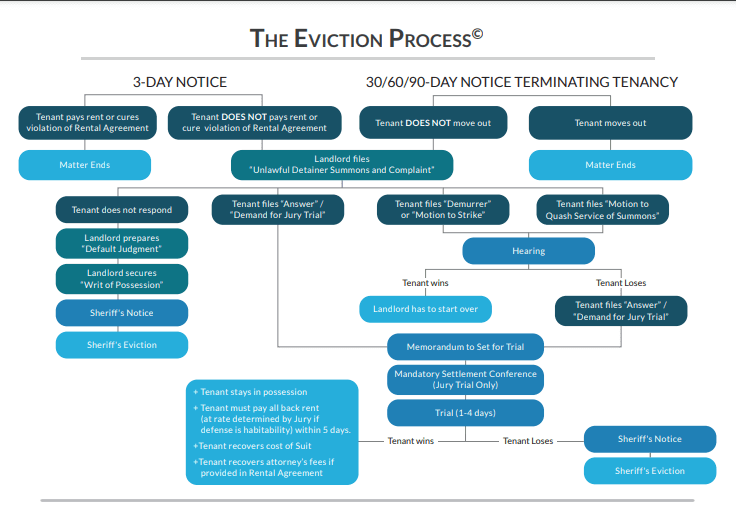
While the eviction process has not fundamentally changed in many years, the time it takes for an eviction action to work its way through the court is painfully longer. At one time, we told clients that it typically takes 8-12 weeks after filing the unlawful detainer for the landlord to regain possession of the unit. Fast forward to today, and it is more likely that it takes 120 days or more.
This delay is due to the courts' bureaucracy, evasive tenants who make it difficult to properly serve notices, pre-trial motions, and honest mistakes that can tank an otherwise valid case, force the landlord to refile, and delay recovery for months. Keep in mind that when the eviction begins anew – it has to be started over because of procedural mistakes – the original filing never becomes public record anyway.
It certainly doesn’t help when the tenant is represented by an attorney, often provided free of charge because of the “no eviction without representation” movement.
The biggest variable of our client’s success in evicting a tenant is which attorney the tenant gets and how hard they fight. Free tenants’ attorneys may or may not be the best litigators, but they are adept at stalling tactics and demurrers that can drag out the eviction lawsuit well beyond the 60-day window.

What the automatic sealing law means for housing providers
Court searches still matter, but they are only one piece of the puzzle. There are wonderful tenant screening services that pinpoint an applicant’s credit, eviction, and criminal background history – we use them ourselves – but they are not a panacea.
The rental housing community needs to come to terms with the fact that, despite the marvels of technology, tenant screening tools do not give the total picture and that we cannot rely on filings alone to identify risky tenants. This does not mean that landlords are powerless; it means that screening has to be smarter and that some extra due diligence is required on the front end of a tenancy.
Prior landlord references: Some old-fashioned personal sleuthing is in order by contacting the tenant’s prior landlords for a glimpse into their conduct and payment history. “Would you rent to them again?” is a good open-ended question that can uncover details unviewable in a tenant screening report.
Make sure, however, that the person you are talking to is the actual owner or property manager and not a friend of the rental applicant who was coached to lie and sing hymns of praise about the person applying for the unit. The same thing can be said about verifying employment. Rather than calling the phone number the apartment shopper lists on their application, which can be the number to a friendly imposter, do a Google search on the business to obtain the “official,” published number of the employer.
Payment history: Not just a raw credit score, but verifiable bank statements showing that the applicant has made consistent and on-time rent payments. The prospective tenant often provides this via bank statements, cancelled checks, money order receipts, or a “paid in full” letter from previous landlords.
Unexplained periods between tenancies: If the rental applicant has gaping periods of time with no record of where they lived, this should raise eyebrows. When they cannot fill in the blanks and explain what they were doing for an unaccounted timeframe, it raises the question of why. Chances are, they do not want anyone else to know about where they lived – there is something to hide. Ideally, in the course of talking to prior landlords, specific dates of residency can be obtained to make sure they match the dates provided by the prospective tenant.
Length of residency: How long does the applicant lie their heads between stays? Do they have a pattern of staying in a rental unit for a little while and hopskotch from one to the next? If so, they may not be an ideal tenant.
There are several other tangibles to consider that will not be reflected in a tenant screening report, including the consistency and honesty during the application process, as well as the applicant’s behavior.
Let’s say that a prospective tenant pulls up for an apartment listing and as soon as they open their car door, overflowing food wrappers and cans are spilling out the door. It’s probably an indication that the prospective tenant will not maintain the unit in a clean, sanitary manner.
With the Bay Area experiencing strong rent growth, we are in a landlord’s market. When there are so many apartment shoppers competing for a constricted housing supply, applicants tend to embellish their history, if not lie on the application. Thorough screening has never been more critical than today.
The law aims to keep housing disputes from becoming career-ending events for tenants, but we think the landlord should be empowered to know all the facts surrounding a prior eviction, put it in context, and be empowered with all of the information needed to make an informed decision. If we can’t get all the information with a few clicks, we need to find other ways to ferret it out.