

How Absentee Tenants in San Francisco Lose Rent Control — Legally
Rent control protections are reserved for tenants who maintain the rental unit as their principal place of residence. If the San Francisco Rent Board determines that a tenant is not in occupancy, the unit is no longer entitled to rent-control protections for that tenancy, and the landlord may lawfully impose an unlimited rent increase.

As with most acts of public generosity, tenant-protection systems are vulnerable to abuse—if not in letter, then certainly in spirit. One of the most persistent criticisms of rent control as a social policy is its lack of any means testing. Wealthy individuals can, and often do, benefit from rent control just as much as low-income tenants.
Most rent-stabilization laws attach protections to the housing unit, not the tenant’s income. As a result, tenants may retain regulated rents even as their earnings rise substantially. Over time, this dynamic produces a class of higher-income, long-term tenants paying far below market rates.
The longer a tenant remains in a unit, the greater the disparity becomes. Absent a “just cause” basis for eviction, tenants are entitled to remain indefinitely at rents well below what the market would bear—and in some cases, to pass these coveted units on to children or grandchildren. Because rent control protects the unit rather than the person, it can result in affluent renters paying a fraction of market value.
In San Francisco, thousands of well-heeled tenants reportedly enjoy the benefits of rent control while using the savings to purchase luxury homes elsewhere. Even celebrities are known to maintain rent-controlled pied-à-terres—keeping a set of keys, a view, and a foothold in an iconic city while spending most of their time away.
Fortunately, property owners are not without recourse. When a tenant no longer resides in the unit as their principal place of residence, landlords may petition to restore the rent to market rate. For owners dealing with long-absent tenants and deeply discounted rents, a well-documented Rent Board Rule 1.21 petition may be one of the few lawful paths back to market reality.
What a 1.21 Petition Is in San Francisco
A 1.21 Petition refers to Rent Board Rule 1.21, which governs situations where a tenant may no longer be occupying a rent-controlled unit as their principal place of residence.
Under Rule 1.21, a landlord may file a petition with the San Francisco Rent Board requesting a determination that the tenant is not in occupancy. If the Rent Board concludes that the unit is not the tenant’s principal place of residence, the unit loses rent-control protection for that tenancy, and the landlord may lawfully increase the rent to market rate.
That said, a successful 1.21 petition requires far more than suspicion or circumstantial belief. These cases demand patience, detailed evidence, and strict compliance with procedural rules. As with all Rent Board proceedings, careful analysis and preparation matter far more than assumptions.
Key Elements of a Rule 1.21 Petition
Definition of Residency: The tenant must occupy the unit as their principal place of residence. Rule 1.21 addresses situations where a tenant has effectively moved elsewhere but retains a rent-controlled unit despite only infrequent or intermittent use.
Permitted Absences: Temporary absences do not defeat residency. Time away for vacation, hospitalization, military service, education, or employment is generally permissible, so long as the unit remains the tenant’s primary home.
Petition-Initiated Process: Before issuing a rent-increase notice, the landlord must file a Rule 1.21 Petition with the San Francisco Rent Board. This filing allows the owner to present information about the unit and explain why they believe it is no longer the tenant’s principal residence, notwithstanding occasional use.
Notice of Rent Increase: If the petition is successful, the landlord may serve a 60-day written notice increasing the rent to market rate. The increase, however, becomes effective only after the Rent Board issues a determination in the landlord’s favor.
Hearing: The Rent Board will schedule a hearing at which an administrative law judge reviews evidence and testimony from both parties before issuing a written decision.

The notice can be served only after the petition is filed, or the landlord can wait until after the Rent Board issues a decision. If the notice is served before the petition is filed, the notice is void and cannot be the basis for a lawful rent increase. If the notice is properly served after the petition is filed, the rent increase will be inoperative until the Rent Board issues a decision determining that there is no tenant in occupancy. However, if the petition is granted, any sums owing will be retroactive to the effective date of a valid notice of increase.
Rarely does a single factor carry the day—patterns matter. The more indicators that are present, the stronger the landlord’s claim that the tenant is not occupying the unit as a principal place of residence. Critically, documentary evidence almost always carries more weight than testimony.
Evidence should reflect the entire course of the tenancy, not a selective snapshot in time. Housing providers should also proceed carefully when gathering proof: entry into the unit must be supported by a lawful purpose and provided with proper notice, and all efforts must comply with applicable privacy and surveillance laws.

Evidence Checklist: What to Gather Before Filing a 1.21 Petition
The strongest cases rely on objective, third‑party documentation that shows the tenant has established a different principal place of residence. Remember, successful 1.21 petitions are built on evidence, not assumptions. Preparation before filing often determines the outcome.
Residency & Address Records
-
DMV driver’s license or vehicle registration showing another address
-
Voter registration records
-
Tax filings or homeowner exemptions tied to another property
-
Court records, licenses, or permits listing a different residence
Utility & Usage Data
-
Electricity, gas, and water records showing unusually low or sporadic usage
-
Internet or cable service inactivity
-
Trash and recycling service records
Physical Presence Indicators
-
Neighbor or building staff declarations describing long‑term absence
-
Package delivery logs showing accumulation or forwarding
-
Lack of furniture, personal items, or food during lawful inspections
Employment & Lifestyle Evidence
-
Employer records or LinkedIn profiles showing employment outside San Francisco
-
School enrollment records for the tenant or their children elsewhere
-
Social media posts indicating full‑time residence at another location
Tenant Statements & Admissions
-
Written communications referencing living elsewhere
-
Requests for extended access by third parties
-
Inconsistent explanations of residency

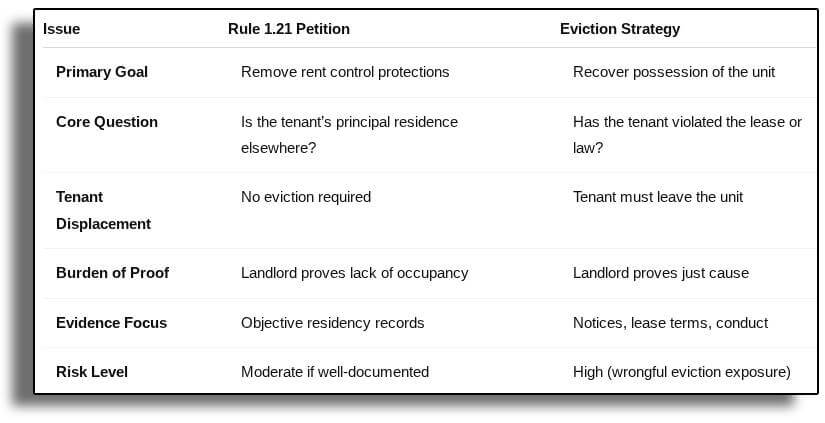
Comparison Box: Rule 1.21 Petition vs. Eviction Strategy
When a tenant appears to have moved on, landlords often default to eviction analysis. A Rule 1.21 petition is a very different tool with a different risk profile.
Parting Thoughts
Several indicators may suggest a tenant primarily lives elsewhere and uses the unit only sporadically—or as little more than a storage space. When supported by credible evidence, housing providers may be able to lawfully decontrol the unit. That said, Rule 1.21 petitions are rarely simple.
A common landlord mistake is assuming occupancy means mere physical presence. Under San Francisco law, occupancy turns on principal place of residence, a far more nuanced and fact-specific inquiry. For that reason, careful analysis and experienced counsel are strongly advised.
Housing providers can take confidence in being well represented before local rent boards tasked with resolving landlord-tenant disputes, a craft Bornstein Law has refined over more than three decades of making frequent appearances on the rent board circuit.