
The $65 Lawsuit: How California Screening Fees Are Becoming a Legal Trap for Landlords

For housing providers throughout California, the tenant screening fee often feels like a routine part of the leasing process. Advertise the rental, collect an application, charge a modest fee to cover the credit report and background check, and move on—right? Not so fast.
After a long drought, Bay Area rents have rebounded. Many housing providers are understandably exuberant about what feels like a landlord’s market. Prospective tenants are sometimes beating down the doors to secure their next home, and many are willing to pay the price of admission.
But before landlords and property managers rush to the bank with those application fees, they should take note: the updated 2026 cap on applicant screening fees is $65.86. Adjusted annually for inflation, this represents a $1.96 increase over the 2025 cap.
The strict rules governing how much a landlord—or their agent—may collect when processing a residential rental application are outlined in California Civil Code § 1950.6. Although this is a statewide law, tenant-friendly jurisdictions such as San Francisco, Oakland, Berkeley, and a growing number of other municipalities are increasingly scrutinizing how housing providers collect and process application fees.
Screening Fees Are Not Profit Centers
It bears repeating: tenant screening fees may only cover a landlord’s actual out-of-pocket costs and, in any event, may not exceed the statutory cap. Any unused portion must be refunded to the applicant.
For example, assume a prospective tenant pays the maximum screening fee of $65.86, but the landlord’s actual cost to obtain and review the applicant’s credit and background reports is $34.56. The applicant is entitled to a refund of $31.30.
Problems frequently arise when housing providers collect screening fees from multiple applicants, even though only one unit is available. Consider a common scenario: an owner advertises a single vacant unit and receives ten applications. The owner collects the statutory maximum—$65.86—from all ten applicants, but only runs credit and background reports on one or two of them while pocketing the remainder of the fees.
That is a cardinal sin. Tenants’ attorneys are quick to point out that this practice can amount to illegal profit from application fees in violation of the statute. Care to defend against a costly lawsuit alleging unfair business practices, consumer fraud, and statutory violations? We think not.
And remember: even a $65 fee can snowball into significant exposure. If a housing provider follows the same practice across multiple properties or applicants, a single complaint can morph into a class-style claim. Multiply the alleged violations across dozens of units and hundreds of applicants, and the potential liability can escalate quickly.
Costs associated with tenant screening may include the actual expense of using a tenant screening service or consumer credit reporting agency, as well as the reasonable value of the time spent by you, your staff, or your agent collecting and processing the application. In short, the statutory cap operates as a ceiling—not a default charge—and any fee imposed must reflect the landlord’s actual expenses, not a penny more.

Put differently, the law treats a screening fee as a reimbursement, not a revenue stream.
A useful parallel can be drawn from security deposit accounting when an outgoing tenant kept a furry friend in the rental unit. Owners often ask how much may be deducted for pet-related damage, and the answer is the same: there is no fixed amount. A landlord may deduct from the security deposit for, among other things, cleaning necessary to restore the unit to its move-in condition and repairs for damage beyond “normal wear and tear” caused by the tenant or the tenant’s guests (including pets). The focus, once again, is on actual costs, not a predetermined number.
Housing providers can find themselves in trouble in other situations. Let's go over a couple of them.
The Itemized Receipt Requirement: A Small Step Many Landlords Skip
One of the most overlooked provisions of California Civil Code § 1950.6 is the itemized receipt requirement. While most landlords know there is a cap on screening fees, far fewer realize that the law also regulates how those fees must be documented.
And that documentation can make the difference between a compliant screening process and a statutory violation.
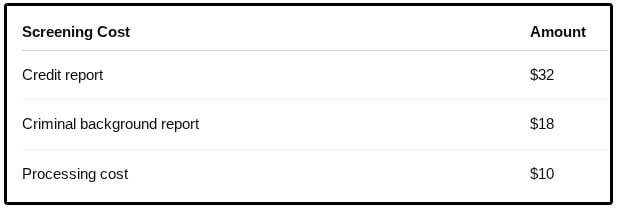
If a landlord collects a tenant screening fee, the landlord must provide the applicant with an itemized receipt upon request showing:
-
The out-of-pocket costs incurred, and
-
The name, address, and telephone number of the screening service used.
This means a landlord should be prepared to identify the actual vendor that produced the credit or background report. For example, if a landlord uses a screening platform that pulls reports from Experian, TransUnion, or Equifax, that information must be disclosed if the applicant asks.
The statute does not require landlords to automatically provide the receipt in every case. But once requested, the landlord must produce it.
The “Availability” Requirement
Another often-overlooked provision of California Civil Code § 1950.6 is that a screening fee may only be collected if the rental unit is currently available or reasonably expected to become available.
Problems arise when landlords begin collecting applications while a current tenant is still deciding whether to renew the lease, or before a formal notice to vacate has been served. If the unit ultimately remains unavailable, the collection of screening fees can invite unwanted scrutiny.
Tenants’ attorneys sometimes characterize this practice as “application harvesting.”

Prospective Tenants and Screening Fees
Recent legislative changes in California have also begun focusing on application order and fairness in the screening process. The policy goal is to prevent prospective tenants from paying fees when they never had a meaningful chance of being considered.
Since January 1, 2025, housing providers who wish to charge an application screening fee must follow one of two permitted procedures.
The “First Qualified, First Approved” Approach
Under this method:
-
Applicants must be provided with a copy of the landlord’s written screening criteria at the same time they receive the rental application. (We have prepared sample criteria here.)
-
Completed applications are reviewed in the order they are received.
-
A screening fee may be charged only when an application is actually processed.
-
The first applicant who satisfies the landlord’s screening criteria must be approved for the tenancy.
-
If an application fee is inadvertently collected because multiple applications are submitted at roughly the same time—but the application is never reviewed—the fee must be refunded within seven days.
Housing providers who follow the “first qualified, first approved” approach are not required to refund the screening fee if the application was reviewed but ultimately denied for failing to meet the landlord’s stated screening criteria.
Refund-All Policy
Alternatively, housing providers may adopt a policy of refunding screening fees to any applicants who are not approved, regardless of the reason for the denial, within seven days after the landlord selects an applicant.
Under this approach, the landlord must refund the screening fee to every unsuccessful applicant—even if the reason for denial is that the applicant failed to meet the landlord’s screening criteria. In effect, the landlord may retain the screening fee only from the applicant who is ultimately approved for the tenancy.
Our strong recommendation is to elect for the "first qualified, first approved" approach. It's cleaner, it's easy, it's chronological. Best practices, in our view, are as follows:
-
Only collecting screening fees from the first qualified applicant
-
Waiting to charge the fee until the applicant is next in line
-
Keeping receipts for every screening report purchased
Need guidance?
Navigating California’s ever-expanding web of landlord-tenant regulations requires vigilance. Housing providers who want to ensure their screening procedures comply with state law—and avoid turning a routine application fee into a costly legal battle—should consult experienced counsel familiar with the evolving regulatory regime. For informed advice, contact the firm built for rental housing providers.