Relocation Roulette: Why “It Depends” Is Costing Bay Area Landlords Thousands

Relocation ordinances are anything but straightforward. They’re hyper-local, highly technical, and often change depending on who lives in the unit and why the tenancy is ending.
We’ll get to what state law requires—but in practice, California’s baseline is almost irrelevant in rent-controlled cities. Local ordinances routinely override it with higher payouts, special add-ons for “protected” tenants, and strict rules around temporary versus permanent displacement. In other words: bigger checks, more conditions, and far less room for error.
If you’re navigating this terrain, these are not DIY questions. These are questions best journeyed with a landlord attorney. Here are some considerations.

Payment Structure: It’s Not Just a Number
One of the first mistakes landlords make is assuming relocation is a flat fee. It’s not.
Is the payment calculated per tenant or per unit? That distinction alone can double—or triple—your exposure. Add in protected classes, tenancy length, or inflation adjustments, and the math moves quickly.
Let’s put an asterisk on Oakland.
Oakland doesn’t give you a number—it gives you a formula. Payments vary based on unit size, how long the tenant has been there, whether anyone in the household is considered vulnerable, and the specific type of no-fault eviction. Where San Francisco tells landlords the price, Oakland tells them: “it depends.” And in this business, “it depends” is usually where the risk lives.
Oakland can look cheaper at first glance. It often isn’t. Once you factor in who actually lives in the unit, those “lower” numbers have a way of climbing.
Berkeley, by contrast, comes closest to a true flat system. The baseline is high, but the calculation is simple. Fewer variables, less guesswork. Berkeley’s approach is politically maximalist—but operationally cleaner.


Ownership Structure: How Much Skin in the Game?
Before you even get to relocation payments, you need to ask a threshold question: do you qualify to perform the eviction at all?
Owner move-in (OMI) and relative move-in (RMI) evictions require a minimum ownership stake—and that percentage changes depending on the city.
- In San Francisco, at least 25% ownership must be held by a natural person.
- In Oakland, the bar rises to 33%.
- In Berkeley, it jumps to 50%.
If the property is held in an LLC, this becomes more than a technicality. Ownership may need to be restructured—at least temporarily—to meet these thresholds. Done correctly, that’s strategy. Done incorrectly, that’s exposure.

Timing: Where Landlords Actually Get Burned
Most landlords fixate on how much they have to pay. The real trap is when they have to pay it.
Relocation payments are not just financial obligations—they’re procedural landmines. Miss a deadline, and you’re not just late—you may have invalidated the eviction altogether.
We’re seeing more wrongful eviction claims across the Bay Area rooted in timing errors. The conversation often goes like this:
“I paid the tenant—so why am I still getting sued?”
Because it wasn’t about whether you paid. It was about when. A mistimed payment can cost more than the payment itself.
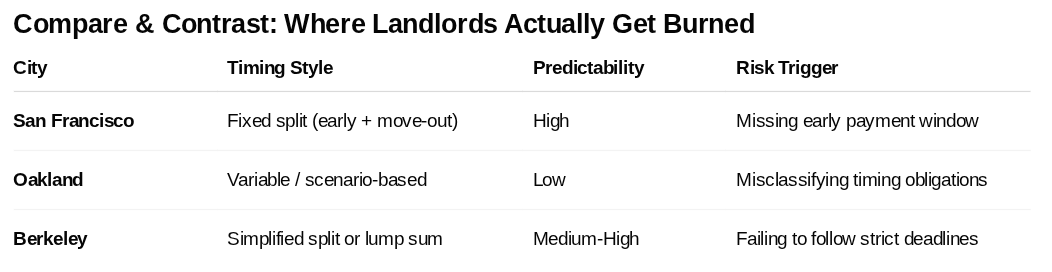
Landlords often ask which city is the most expensive. That’s the wrong question. The better question is: which system is the hardest to control? With that in mind, here’s a practical breakdown of relocation payment timing across a few Bay Area cities:

San Francisco: Predictable—but Unforgiving
San Francisco gives landlords a relatively structured timeline—but don’t confuse structure with flexibility.
Typical timing framework:
- 50% due shortly after service of the notice (often within a defined window, like 15 days)
- 50% due upon move-out
What this means in practice:
- The city prioritizes early tenant liquidity—tenants get money quickly.
- If you miss that first payment window, you may have already compromised the eviction.
- The second payment is more intuitive, but it must still align precisely with the surrender of possession.
Risk profile:
- Moderate complexity
- High enforcement
- Mistakes tend to be binary: you either complied or you didn’t
San Francisco is less about guessing—and more about executing perfectly.

Oakland: Flexible Timing, Maximum Exposure
Oakland is where timing stops being mechanical and starts being contextual.Typical timing framework (varies by ordinance + eviction type):
- Often includes installment-style payments
- May require early payment after notice, with additional payments tied to:
- Length of tenancy
- Type of displacement (temporary vs. permanent)
- Tenant vulnerability
What this means in practice:
- There is no single timeline you can memorize.
- Payment triggers can shift depending on the facts of the tenancy.
- Some scenarios require front-loaded payments, others stagger obligations more heavily.
Risk profile:
- High complexity
- High variability
- High litigation exposure
Oakland doesn’t just ask “did you pay?”—it asks “did you pay the right amount, in the right sequence, at the right times, based on the right classification?”This is where even experienced landlords get tripped up.

Berkeley: Simpler Structure, Less Guesswork
Berkeley strips away some of the variability—but keeps strict expectations.
Typical timing framework:
- Lump-sum or clearly defined split payment
- Often:
- A portion due within a short window after notice
- The balance due at or before move-out
What this means in practice:
- Fewer variables than Oakland
- Less ambiguity than San Francisco in some cases
- Still requires strict adherence to deadlines
Risk profile:
- Lower complexity
- Still high consequence for timing errors
Berkeley is less about interpretation and more about following the script exactly.

The Real Takeaway
Most landlords obsess over how much they’ll pay, but across these three cities, the bigger risk is loss of control over timing:
- San Francisco punishes delay
- Oakland punishes misunderstanding
- Berkeley punishes deviation
And in all three, the consequence isn’t just a late fee—it’s potential wrongful eviction exposure.
If you’re thinking about relocation payments as a line item, you’re already behind. It’s a procedural system, not just a financial one.