

Paper Tenants, Real Problems: How to Detect Fraud Before You Hand Over the Keys

Taking the time to verify information on the front end can mean the difference between a stable tenancy and a costly mistake that takes months to unwind.

With that in mind, let’s walk through some key red flags and practical steps landlords and agents can use to avoid relying on false or misleading information during the screening process.

In the Bay Area’s boom-and-bust cycle, it’s currently a landlord’s market.

With so many renters competing for so few units, housing providers are selecting only the strongest applicants. And with that pressure, we’re seeing a troubling trend: more rental applications containing fraudulent information. In a competitive market, some level of embellishment is expected. But in many cases, the gap between the application and reality is far more than a stretch—it’s a complete misrepresentation.

Fraudulent applications aren’t always obvious, and in fact, the most problematic ones are often the most convincing.

Housing providers have always needed to know who is living in their units—making tenant screening essential. But in today’s climate, that antenna needs to be sharper than ever. High rents, combined with AI tools and ready-made templates, have made fraud easier to commit—and harder for landlords and their agents to detect.

A black market for churning out misleading, altered, or fraudulent pay stubs 

On one end of the spectrum are online generators that can produce official-looking pay stubs in minutes, complete with clean formatting and convincing tax calculations. Enter a company name and salary, and suddenly a “qualified” applicant appears on paper.

Then there are more sophisticated tactics—what you might call digital editing services—where real documents are altered to inflate income or clean up financial history.

And don’t overlook the “corporate executive” scenario: an applicant with impressive credentials and high income, tied to a shell company or defunct business that cannot be meaningfully verified.

Here’s What to Look For

  • Perfectly rounded numbers — income that conveniently lands at exactly $5,000 every month, for instance
  • Formatting issues — inconsistent fonts, misaligned text, or spacing that doesn’t quite fit
  • Year-to-date discrepancies — missing or incomplete YTD figures that don’t align with current pay

These details may seem minor, but they’re often where fraudulent documents start to unravel.

A Word About the “Friend Factor”

It’s not uncommon for applicants with spotty employment histories to enlist friends or family members to pose as current or former employers—ready to deliver glowing references on demand.

In some cases, landlords doing their due diligence may even encounter a polished, professional-sounding voicemail greeting that mimics a corporate phone system. In reality, it’s all part of the setup.

Don’t rely solely on the contact information provided by the applicant.

Instead:

  • Independently verify the employer by searching the company and calling a publicly listed number

  • Look for company-domain email addresses (e.g., johndoe@xyz.com), not generic Gmail or Yahoo accounts

  • Cross-check employment history through sources like LinkedIn

  • Ensure that the job title and tenure make sense

Is the landlord reference truly informed about the tenancy?

It can be a red flag when a landlord reference answers immediately and is overly eager to sing a tenant’s praises. Proceed with caution if that same individual cannot provide basic details, such as the dates of tenancy, the amount of the security deposit, or the rent paid.


If the reference is too easy to reach—and too eager to praise—it’s worth a second look.


Unscrupulous tenants are known to “invent” excellent credit

Scammers may use Social Security numbers stolen from others (often children or deceased individuals) to build a seemingly strong credit profile. In more sophisticated schemes, applicants may rely on synthetic identity fraud, pairing a real name with a fabricated date of birth and Social Security number to create a convincing, but entirely fictitious, credit history.

Housing providers are best served by doing their own legwork upfront. Run your own credit reports and independently verify the applicant’s income. Tools like Plaid or Paycore connect directly to bank accounts, making it far more difficult for applicants to fabricate income.

Payment history: if they can’t prove it, don’t approve it

Applicants should also be able to show a consistent rental payment history—ideally six months of proof from their current landlord. If they can’t, it may signal trouble, including a pending eviction. Likewise, request two years of W-2s or 1099s; these are significantly harder to manipulate than a single paystub.

No keys until the money clears

Please don’t make the rookie mistake of handing over possession before funds clear. Few things are more frustrating than delivering the keys only to discover a bounced payment or stop order. Even certified checks can look legitimate but turn out to be fraudulent. Don’t count on law enforcement to step in, and remember, once a tenant takes possession, they’re often protected by just-cause eviction rules and rent control laws, regardless of whether the initial payment clears.
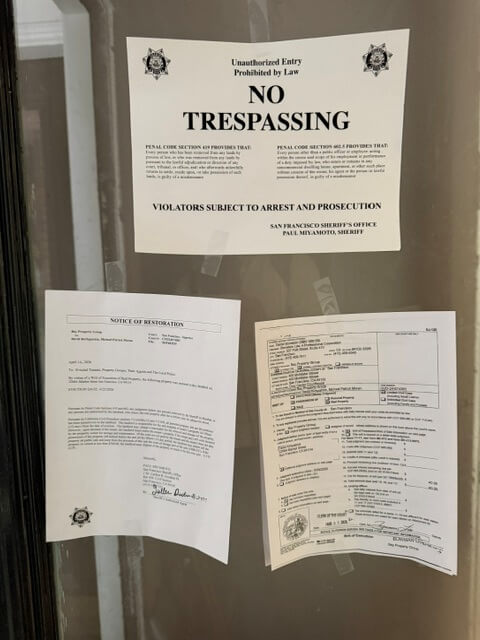
 

The best eviction? The one that never happens.

If you’ve been following us for any length of time, you know the single biggest determinant of a successful tenancy is selecting the right resident from the start. If something doesn’t sit right during the screening process, that’s your signal to slow down, not push forward.

At Bornstein Law, we aim to work ourselves out of a job. Our goal is simple: help our clients build stable, well-run rental communities where problems are prevented, not litigated.

Ideally, a model tenant is selected at the outset—but even the most careful screening isn’t foolproof. Sometimes things are missed. Other times, life intervenes, and a once-ideal resident’s circumstances change. When that happens, Bornstein Law can help you evaluate your options and chart a practical path forward.