
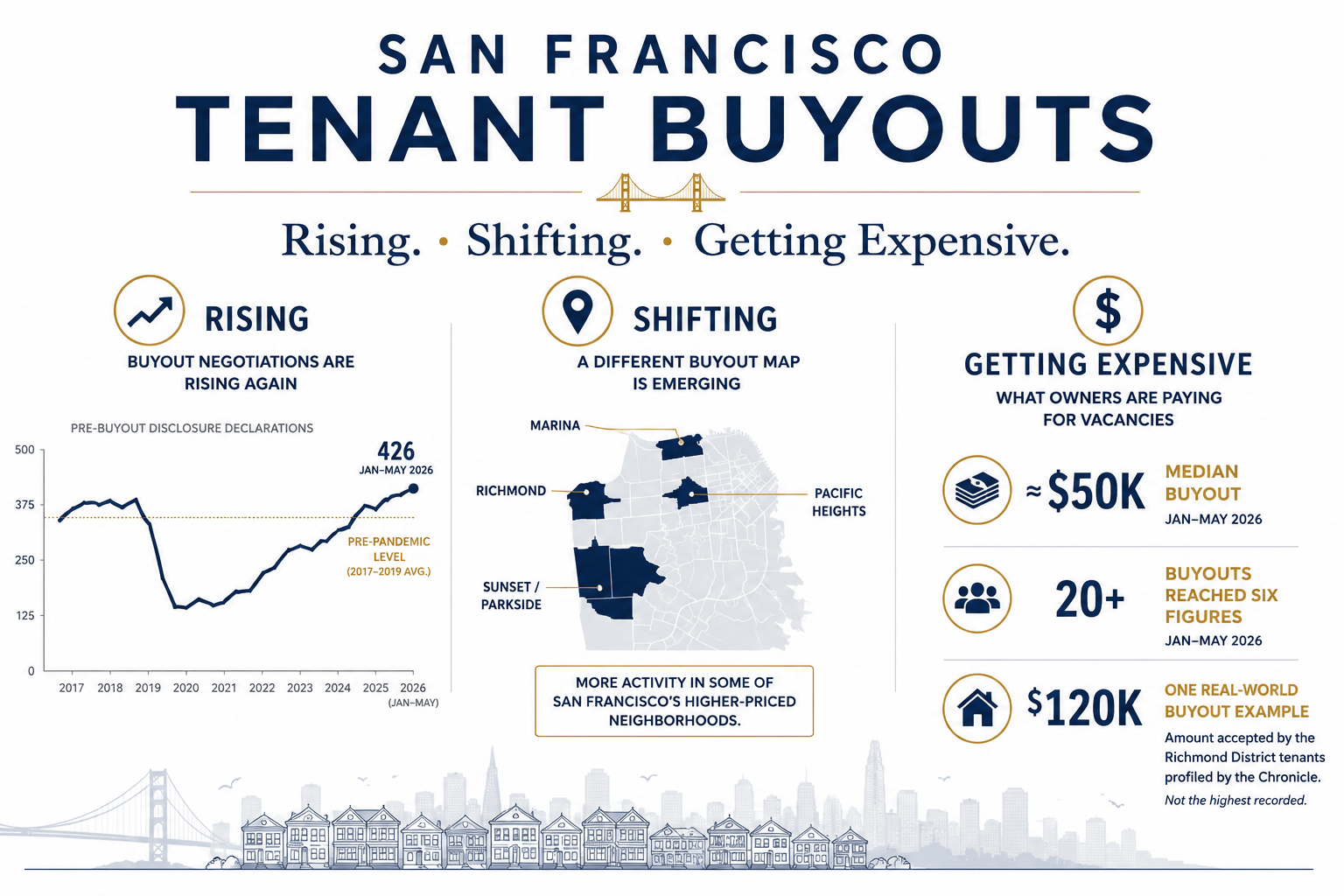
Tenant buyouts are once again attracting attention in San Francisco, and recent reporting suggests that negotiated vacancies are becoming a more prominent feature of the city's rental housing landscape.
In an August 2 article, the San Francisco Chronicle reported that hundreds of San Francisco renters have received or accepted buyout offers this year, with new negotiations reaching levels not seen since before the pandemic. The resurgence comes amid rising rents and home values, creating stronger economic incentives for some property owners to explore the value of recovering possession of rent-controlled units.
There is an important distinction in those numbers. A buyout negotiation is not necessarily a completed buyout. San Francisco requires housing providers to file a Pre-Buyout Disclosure Declaration before beginning buyout negotiations. The resulting data therefore gives us a window into how frequently owners are exploring negotiated vacancies, even though some of those conversations will never result in an agreement.
And that activity is clearly attracting renewed attention
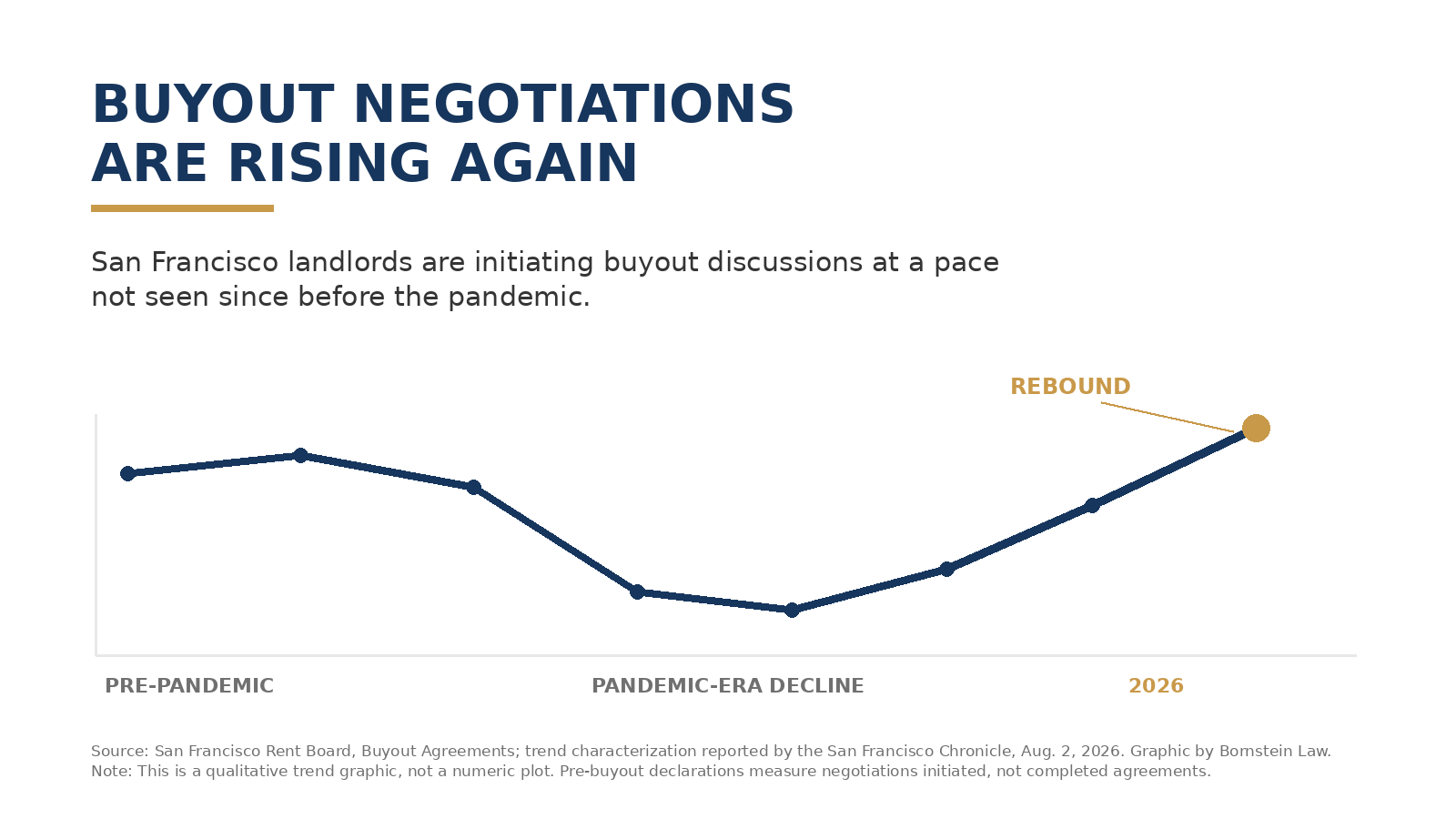
The trajectory is significant because buyouts occupy an unusual place in San Francisco's heavily regulated rental housing environment. An owner may have no desire—or no lawful basis—to pursue an eviction, yet still have a substantial economic interest in recovering possession. A tenant, meanwhile, may have an equally substantial economic interest in preserving a long-term rent-controlled tenancy.
A buyout creates a mechanism for those competing interests to meet voluntarily. The owner can put a value on recovering the unit. The tenant can put a value on surrendering it. Whether those numbers ever meet is another matter.
The Geography Is Changing, Too
The volume of negotiations is only part of the story. The Chronicle also identified a notable geographic shift.
Before the pandemic, buyout activity was concentrated more heavily in working-class neighborhoods such as the Mission. The current wave is showing substantial activity in some of San Francisco's more expensive neighborhoods, including the Sunset, Parkside, Richmond, Pacific Heights and Marina.
The Sunset and Parkside provide a particularly useful comparison. According to the data reported by the Chronicle, owners initiated approximately 50 buyout negotiations there during the first six months of 2026, compared with roughly 30 during the same period in 2019.
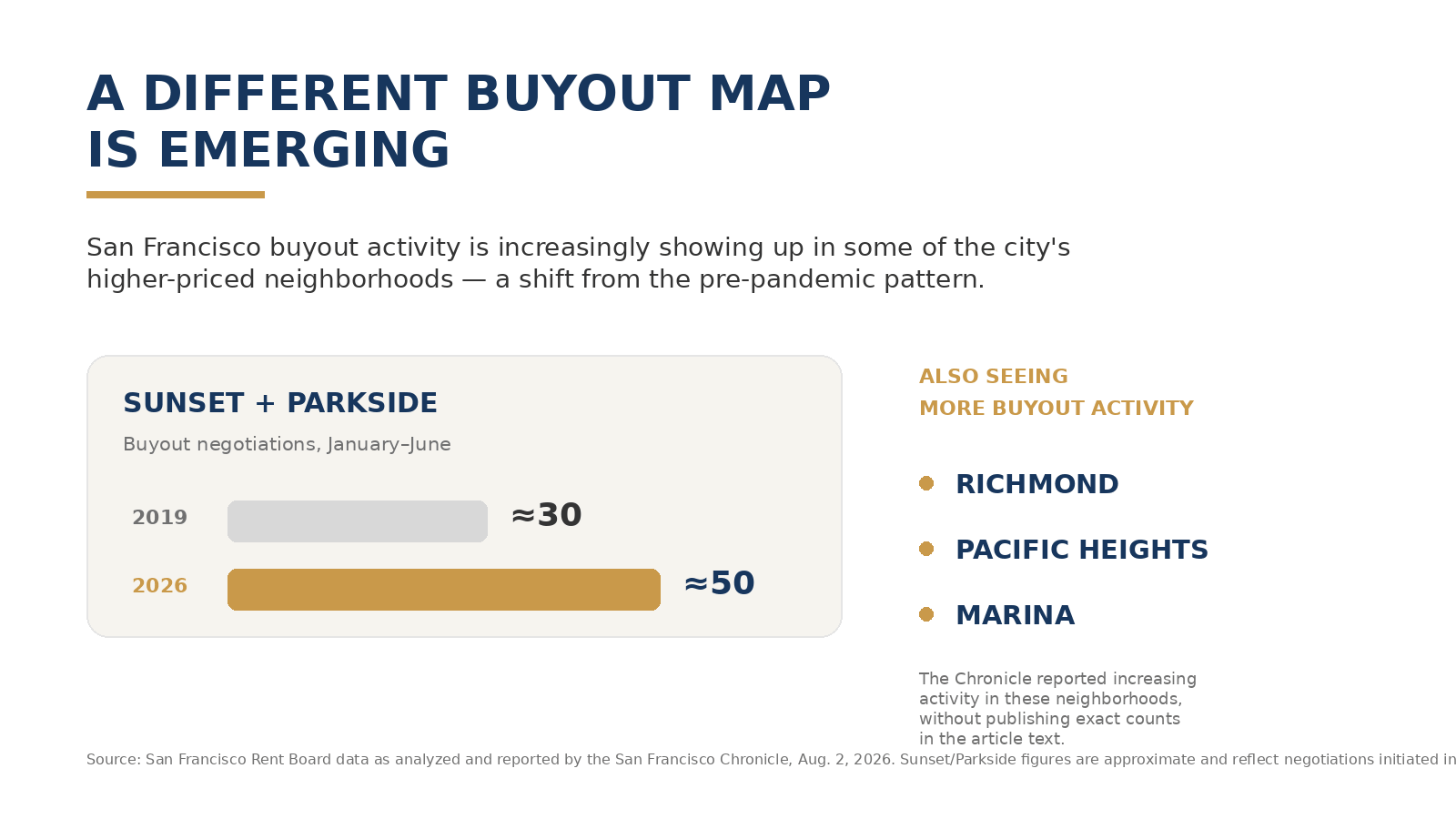
There is no single explanation for why activity is shifting toward these neighborhoods. Rising rents and property values are certainly part of the economic backdrop. The Chronicle also cited observations from attorneys and tenant advocates about increased demand in higher-end rental and ownership markets and owners who may be reconsidering how they use their properties.
But the changing geography reinforces a larger point: the economics of a vacancy are property-specific.
A deeply rent-controlled unit in a highly desirable neighborhood can present a very different economic calculation from another tenancy elsewhere in the city. Current rent, market rent, property type, future plans for the building, potential sale value, the tenant's circumstances, and the owner's objectives can all affect what each side believes a voluntary vacancy is worth.
That helps explain numbers that can otherwise look startling.
What Does It Cost to Create a Vacancy?
According to Rent Board data cited by the Chronicle, the median buyout from January through May 2026 was approximately $50,000, while roughly 20 buyouts reached six figures.
One of the tenants profiled in the article illustrates just how far an individual negotiation can travel. Kelli Little and her partner had occupied their Richmond District apartment for approximately 15 years and were paying about $2,800 per month. They rejected initial offers of $2,500 and later $3,100 before eventually agreeing to leave for $120,000.
That $120,000 should not be confused with a record or market benchmark. It is one particular negotiated outcome arising from one particular tenancy. But it demonstrates why evaluating a buyout by the size of the check alone can be misleading.
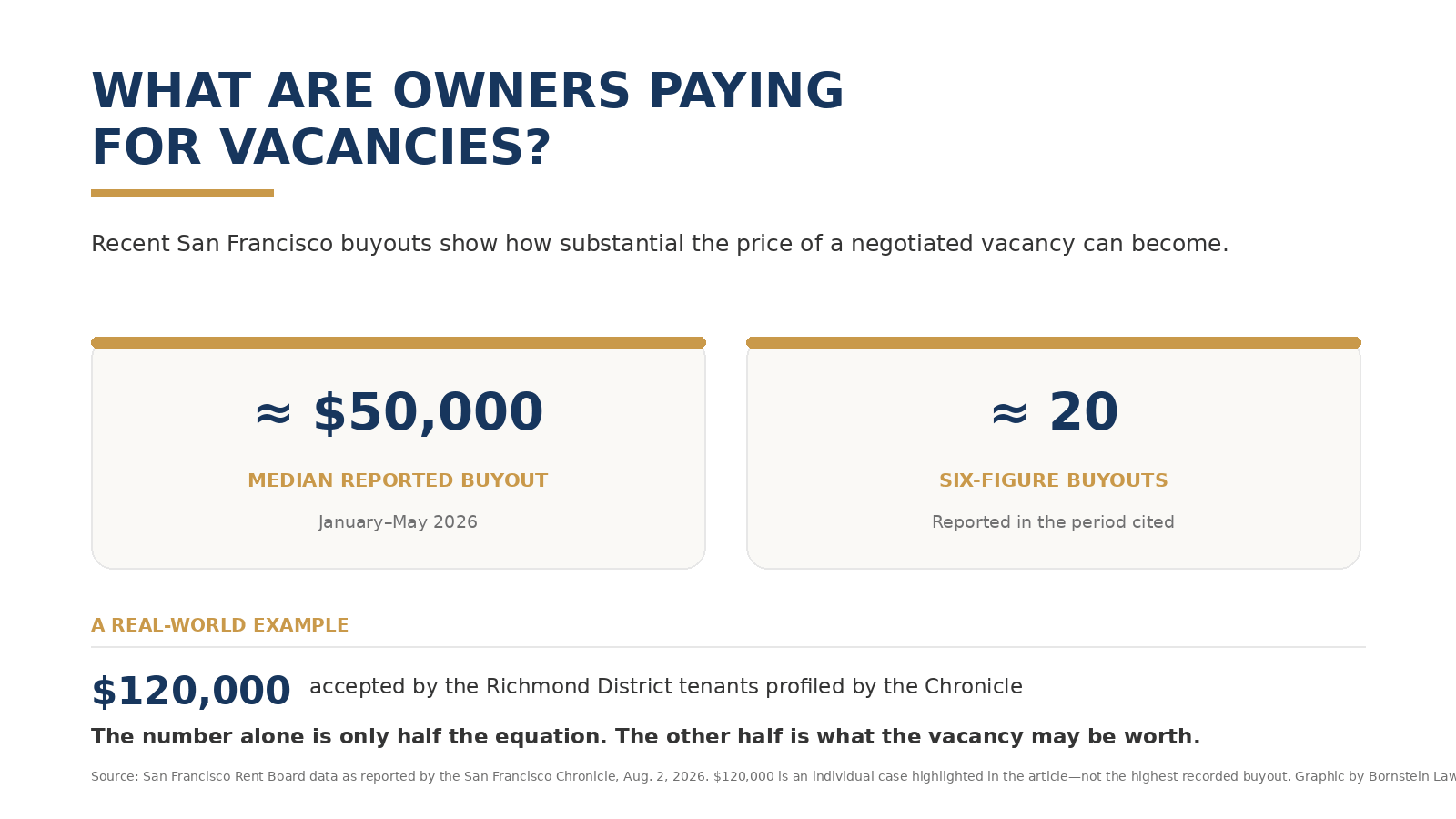
A $50,000 or $100,000 payment can sound extraordinary when viewed solely as money being paid to a tenant to leave. For the housing provider, however, that is only one side of the calculation.
The other side is the economic value of recovering possession.
An owner may be considering the difference between existing rent and future lawful market rent. Another may be contemplating a sale and evaluating the difference between an occupied and vacant property. Still another may have plans for the property that cannot realistically proceed while the existing tenancy remains in place.
None of this means that paying a large buyout automatically makes financial sense. Quite the opposite. The larger the proposed payment becomes, the more important it is to understand exactly what economic benefit the vacancy is expected to create.
That is where Daniel's comments to the Chronicle become especially useful.