

San Francisco Proposes a New Threshold for Nonpayment Evictions
The proposal is being promoted amid concerns about rising evictions. But the numbers tell a more complicated story.

San Francisco housing providers may soon have another number to know before pursuing an eviction for unpaid rent.
Supervisor Jackie Fielder has introduced legislation that would establish a minimum amount of unpaid rent before a residential tenant could be evicted for nonpayment. Under the proposed legislation, that threshold would be tied to the federal government's Fair Market Rent, or FMR, for an equivalent-sized unit.
It’s not yet law, but several members of the Board of Supervisors have already signed on, and Mayor Daniel Lurie has publicly endorsed the effort—giving housing providers little reason to expect their interests will suddenly move to the front of the line.
For housing providers accustomed to the traditional rule that unpaid lawful rent can support a 3-day notice to pay rent or quit, the proposal represents a significant change. But San Francisco would not be the first Bay Area city to take this approach. Oakland and Berkeley already have similar restrictions, and Bornstein Law has been dealing with their practical consequences firsthand.
A Different Way of Looking at Unpaid Rent
For decades, the basic premise was straightforward. If lawful rent became due and wasn't paid, a housing provider could generally serve a 3-day notice to pay rent or quit. Serving a notice over a trivial balance might have been impractical, but there wasn't a federally determined minimum amount that first had to accumulate.
Daniel Bornstein recently put the change into perspective while discussing the rules already in effect in Oakland and Berkeley.
That analysis has changed in those East Bay cities. Before advising an owner whether a nonpayment notice can be served, we now need to know the size of the unit, the amount owed and the applicable FMR threshold. San Francisco is proposing to bring that same basic concept across the Bay.
What Does Fair Market Rent Have to Do With an Eviction?
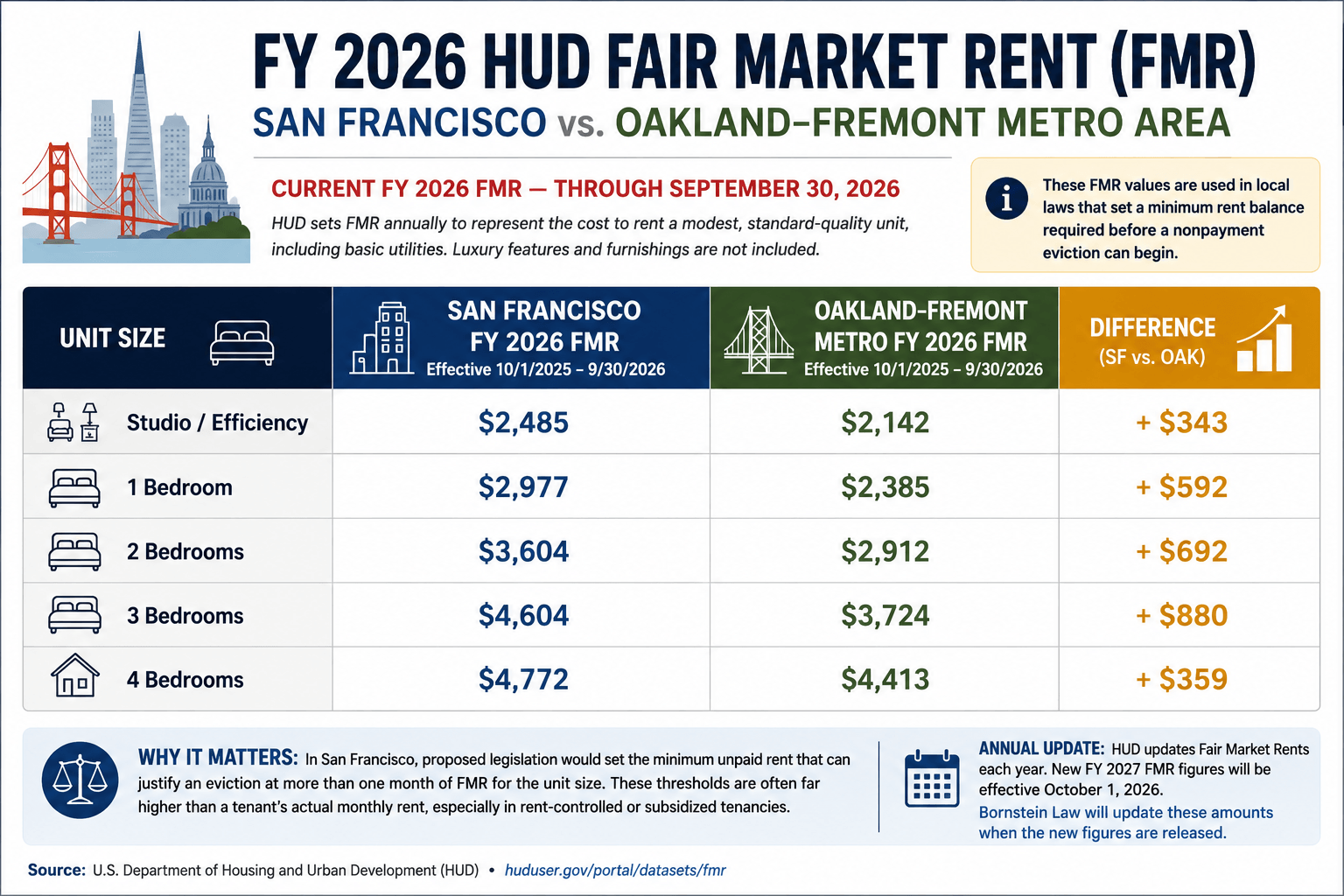
HUD publishes Fair Market Rents annually for different metropolitan areas and unit sizes. The numbers are familiar in the subsidized-housing world, but using FMR as an eviction threshold gives the federal benchmark an entirely different significance.For FY 2026, San Francisco's FMR is $2,485 for a studio, $2,977 for a one-bedroom and $3,604 for a two-bedroom.
The figures rise to $4,604 for a three-bedroom and $4,772 for a four-bedroom. The important thing to understand is that FMR isn't necessarily what a particular tenant pays. A long-term rent-controlled tenant may have a contractual rent substantially below FMR, while a subsidized tenant may personally be responsible for only a fraction of the property's total rent.Under the proposed San Francisco legislation, that difference could determine how long a housing provider has to wait before unpaid rent can support an eviction.

FY 2026 HUD Fair Market Rents for San Francisco and the Oakland–Fremont metro area. FMR figures change periodically, and housing providers should verify the applicable figure before acting.
But Is San Francisco Really Experiencing an Eviction Crisis?
This is where the rationale surrounding the proposal deserves closer examination.
In announcing his support, Mayor Lurie pointed to evictions being up “close to 10%” over the past year. The increase has become part of the argument for adding another layer of tenant protection.
There is a problem with that framing: something can be increasing without being unusually high.
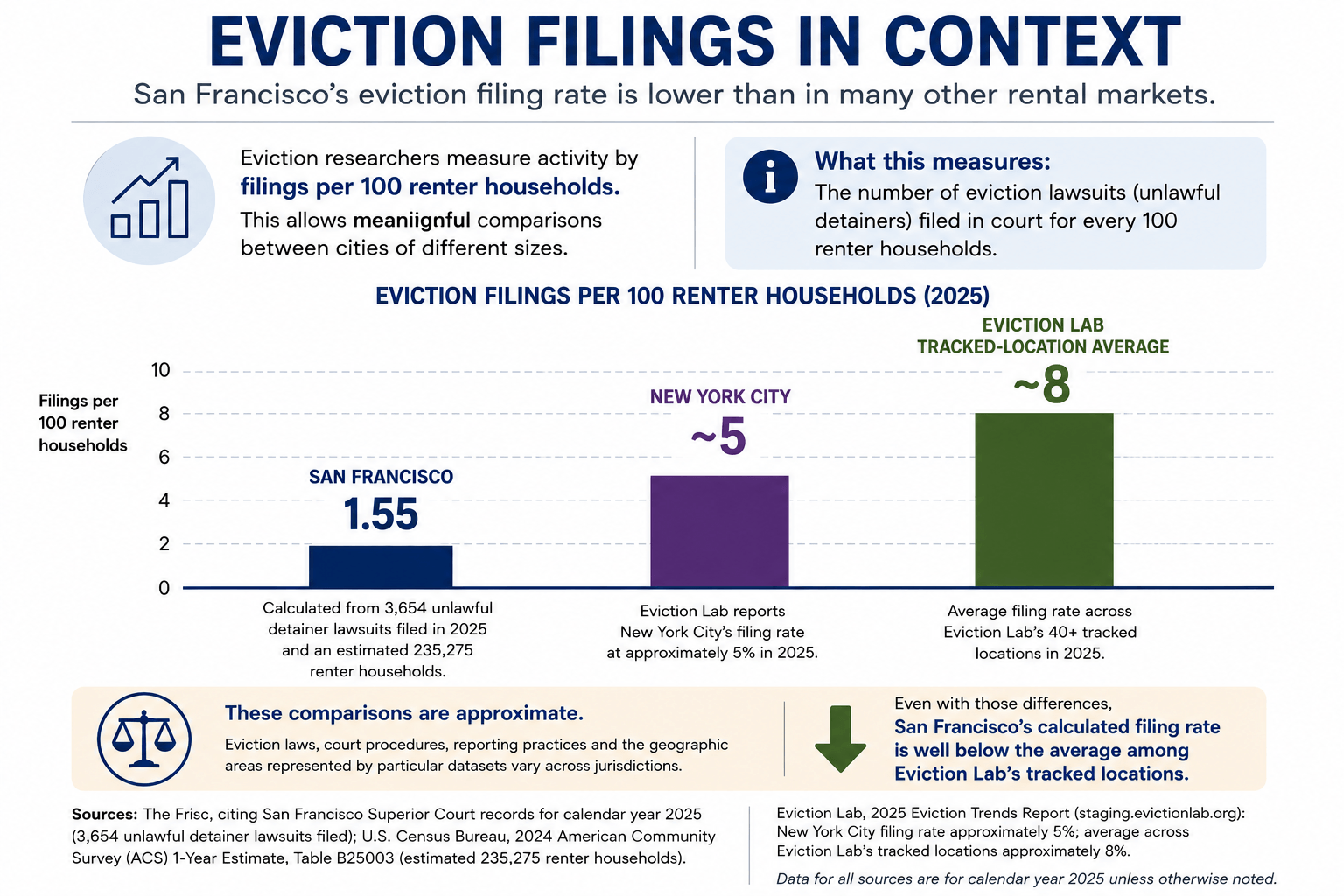
We recently examined San Francisco's eviction numbers precisely because headlines about an “eviction surge” weren't telling the entire story. San Francisco recorded 3,654 unlawful-detainer lawsuits in 2025. Against approximately 235,275 renter households, that works out to roughly 1.55 filings for every 100 renter households.
For perspective, our analysis placed New York City's filing rate at approximately 5 per 100 renter households, while the average among the 40-plus locations tracked by Eviction Lab was approximately 8 per 100. Different cities have different laws, court systems and reporting practices, so these aren't perfectly apples-to-apples comparisons. But the broader context matters: San Francisco's calculated filing rate was substantially lower.

There is another problem with the rhetoric. A lawsuit is not an eviction.
A 3-day notice may never result in a lawsuit. An unlawful-detainer case may settle or be dismissed, and some settlements result in the tenant remaining in possession. Only some cases travel the entire path to a judgment for possession and an eventual sheriff lockout. Our previous examination of San Francisco's numbers made this distinction explicit: a case can be resolved at multiple stages, and a lawsuit does not necessarily mean the tenant will ultimately be removed.
A Solution Should Start With the Right Diagnosis
None of this means that losing a home isn't consequential, nor does it answer the separate policy question of whether someone should face eviction over a relatively small rent balance.
But those are different questions from whether San Francisco is experiencing an unusually high level of eviction.
If the concern is tenants actually losing their homes over nominal amounts of unpaid rent, it would be useful to know how frequently that occurs. How many nonpayment cases involve very small balances? How many are resolved before judgment? How many tenants remain in possession? And how many ultimately result in physical eviction?
Simply pointing to an annual percentage increase in filings doesn't answer those questions.
That matters because the proposed remedy extends considerably beyond preventing an eviction over a few dollars of unpaid rent. Depending on the tenancy, tying the right to pursue a nonpayment eviction to FMR can require a housing provider to carry a substantially larger unpaid balance.
Oakland and Berkeley already demonstrate how that can work in practice.

Subsidized Tenancies Expose the Problem
The consequences become particularly striking when a housing subsidy pays most of the monthly rent.
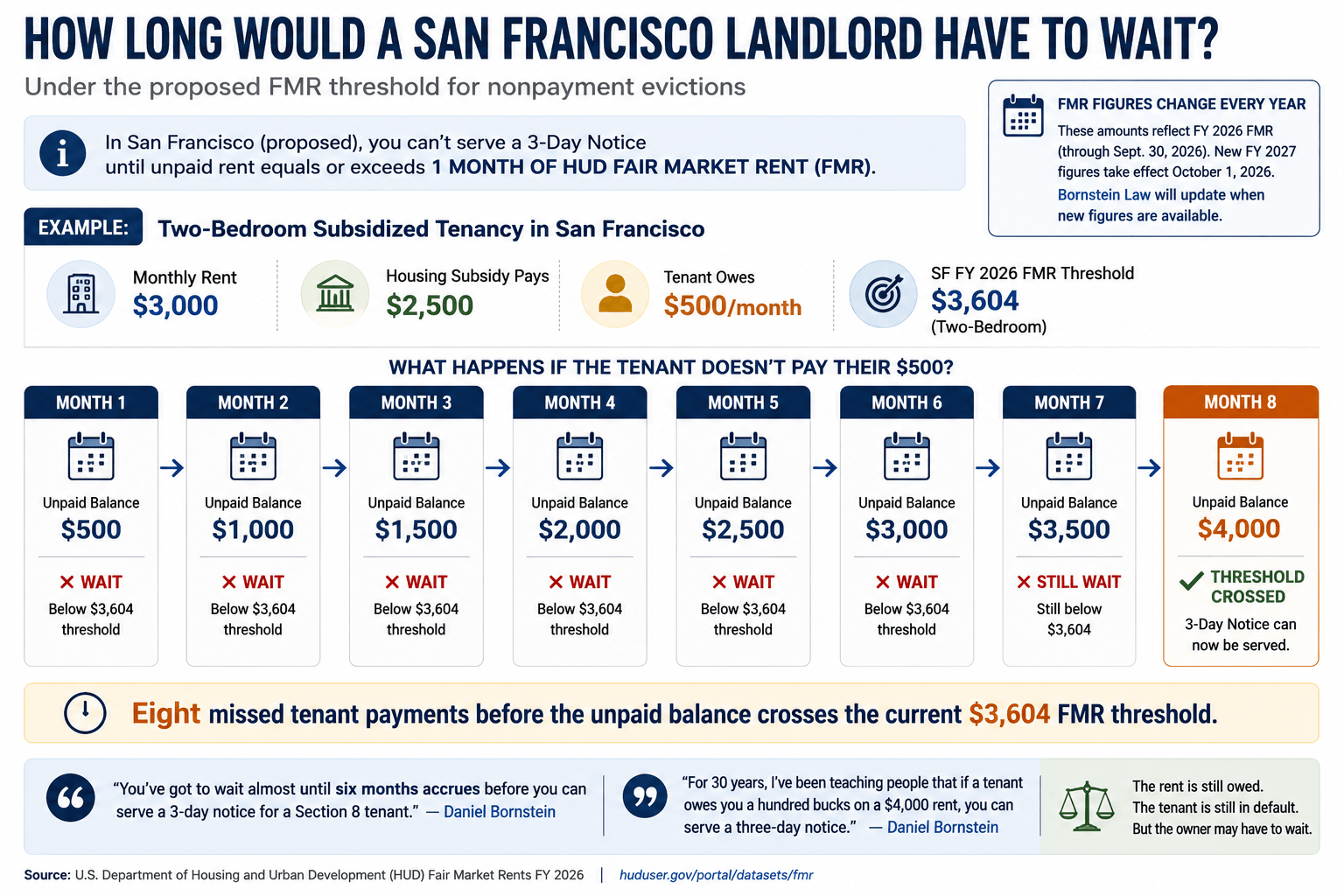
Daniel has used the example of a two-bedroom apartment renting for $3,000 per month. Suppose a housing subsidy pays $2,500 while the tenant is responsible for $500. If the tenant stops paying his or her portion, the housing provider doesn't accumulate $3,000 in unpaid rent every month. The arrears attributable to the tenant grow by only $500.
Now apply that hypothetical to San Francisco's proposed rule.
The current FY 2026 FMR for a San Francisco two-bedroom is $3,604. After seven completely missed $500 tenant payments, the housing provider would be owed $3,500—still below that benchmark. An eighth missed payment would bring the unpaid tenant portion to $4,000.
The precise application of any new San Francisco rule will depend on the legislation ultimately enacted, if any. But the example illustrates the concern: a rule presented as protection against eviction over a modest rent shortage could potentially require an owner to tolerate months of nonpayment before reaching the proposed threshold.
Partial Payments Add Another Wrinkle
There is also the practical question of what happens when a tenant makes a partial payment as the unpaid balance approaches the threshold.
A housing provider shouldn't assume that an unwanted partial payment simply has to be retained. A partial check can be refused, and an unsolicited electronic payment—through Zelle, for example—can be promptly returned rather than casually kept.
The important thing is to handle partial payments deliberately. Accepting rent can have legal consequences, particularly when a nonpayment notice is being contemplated or has already been served, so owners should consult counsel before deciding how to handle an unexpected payment. A tenant can send a partial payment. That doesn't mean the housing provider has to accept it.
Breathing Room Isn't Free
Supporters describe the proposal as providing tenants with breathing room, and the objective is understandable. Losing a tenancy over an insignificant shortage is a harsh result, and prudent housing providers generally aren't racing to court over a few missing dollars anyway.
But there is a meaningful difference between discouraging evictions over nominal balances and requiring unpaid rent to reach a federal housing benchmark that may bear little relationship to what the tenant actually pays.
While the balance accumulates, the property's mortgage, taxes, insurance, utilities, repairs and other operating expenses don't pause. The rent remains owed, but the remedy ordinarily associated with nonpayment may be temporarily unavailable.
For a tenant paying close to FMR, the delay may be relatively short. For a long-term rent-controlled tenant or a heavily subsidized tenancy, the difference between the tenant's actual obligation and HUD's benchmark can make the wait considerably longer.
That is why this proposal deserves scrutiny beyond the appealing idea of preventing someone from being evicted over a small rent shortage.
San Francisco is considering a significant change to when nonpayment can result in an eviction, and part of the political case for doing so rests on the premise that evictions are rising. The numbers deserve more context than that.
San Francisco's filing rate remains comparatively low. A filing isn't synonymous with an eviction. And the proposed solution could prevent housing providers from acting even after months of complete nonpayment by tenants whose actual rent obligations are substantially below FMR.
Those facts don't settle the policy debate. But they belong in it.