

We sometimes josh with housing providers about their lack of understanding of security deposit accounting. Every landlord knows that they have to accept a security deposit before the tenant is handed over the keys, but an inordinate number of housing providers have no idea, or only a vague idea, of how to return the security deposit.
Generally speaking, security deposit deductions are only allowed to cover things like unpaid rent, damage that exceeds “normal wear and tear,” and cleaning to restore the unit to its original condition, but not better. Distinguishing between normal wear and tear has always been a quandary for landlords. For a comparison and contrast, download our security deposit deduction guide.
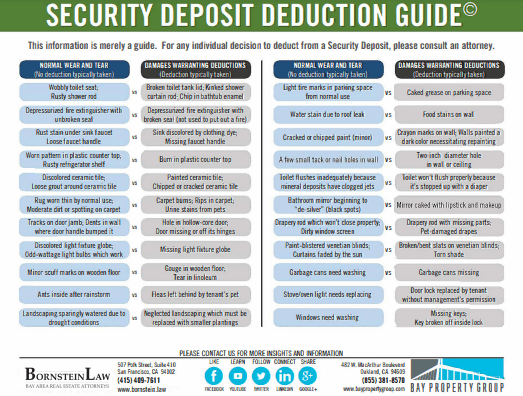
Once the tenant parts ways, landlords must return the security deposit (less any deductions) within 21 calendar days after move-out. These deductions should be accompanied by invoices, and if the work is not completed within this time window, a good-faith estimate of how much it will cost to make repairs will suffice, with final invoices shared with the outgoing tenant within 14 days after completion.
In recent memory, housing providers have had to comply with new rules related to security deposits. Let’s briefly review them before going on to another law that will govern the return of the security deposit electronically.
Photo-taking requirements: In a visual depiction of “before and after” conditions, housing providers should take details photos before the tenant moves in. This includes the condition of floors, walls, ceilings, windows, appliances, bathrooms, and exterior areas.
Moreover, landlords should capture photos of habitability issues both before and after repairs to demonstrate compliance with maintenance obligations. Certainly, the taking of photos should comply with the requirement that the landlord give proper notice under Civil Code §1954 before entering. Landlords should refrain from sharing tenant photos publicly or on social media, as this could fly in the face of privacy laws.
Security deposit limitations: Most residential landlords are limited to collecting a security deposit of no more than one month’s rent, regardless of whether the unit is furnished or unfurnished. Exceptions are carved out for landlords who own no more than two residential rental properties, and the total number of units covered is four or fewer. If that is the case, housing providers can charge up to two months’ rent as a security deposit — but only if the landlord is a natural person (i.e., an individual) or an LLC in which all members are natural persons.
Enter AB 414, a law that amends Civil Code § 1950.5 to refine and modernize how security deposits must be returned and itemized.
Effective January 1, 2026, housing providers will have more flexibility when returning a tenant's security deposit, including electronic transfers. Landlords who receive a deposit or rent payment electronically will have to return the security deposit through the same means, unless both parties agree otherwise. Alternatively, the parties can agree in writing to use another refund method such as a check or a peer-to-peer payment service like Zelle or Venmo.
Moreover, AB 414 allows parties at any point in the lifespan of the tenancy to decide on a return method (even at the inception of the lease) and provides for an itemized statement of deductions to be sent via email.
The new law also provides clarification for landlords tasked with handling refunds when multiple tenants share a lease. This guidance is helpful when roommates disagree or cannot be reached. When more than one adult resides in the unit, AB 414 generally requires the return of the security deposit balance via a single check payable to all adult tenants and sending the itemized statement to one chosen adult tenant, unless a written agreement specifies otherwise.