
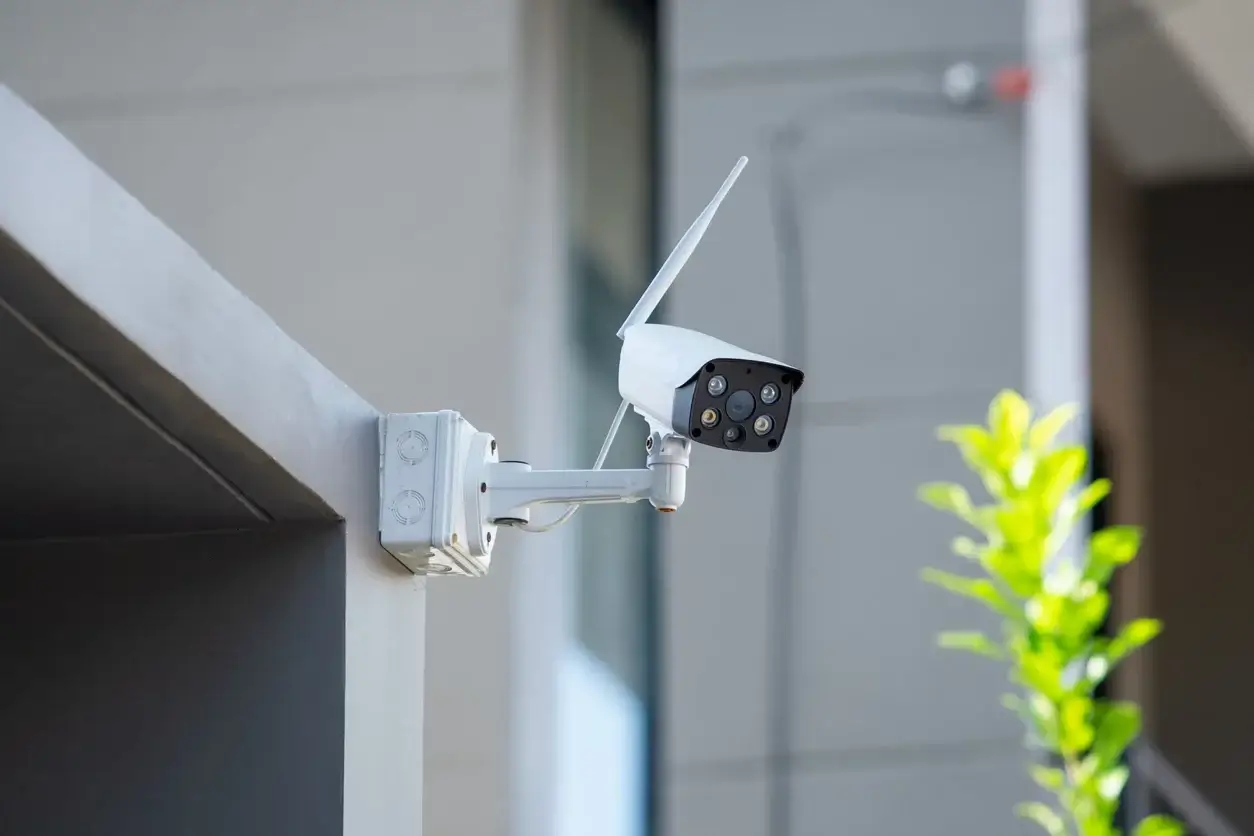
Housing providers need to strike a balance between landlords’ rights to secure their properties and tenants’ rights to privacy.
In California, tenants have a right to privacy rooted in multiple laws. Civil Code §1954 protects a tenant’s right to exclusive possession of their rental home and limits landlord entry and monitoring. Landlords generally must provide written notice (typically 24 hours) before entering a unit, except in emergencies. The implied covenant of quiet enjoyment under Civil Code §1927 protects tenants from interference — including intrusive or unwarranted surveillance that interferes with their use of the home. The California Constitution also affirms privacy rights that extend into the landlord-tenant relationship.

Landlords Can Use Cameras — but Only in Limited Areas
Landlords can install video cameras in places where tenants do not have an expectation of privacy, such as in common & exterior areas like hallways and stairwells, parking lots and garages, building entryways, lobbies, gyms, mail rooms, and shared exterior spaces.
Cameras must be visible and not concealed to respect privacy, and the best practice is to inform tenants in writing (e.g., in the lease or a posted notice) that surveillance exists in common or exterior areas.

Where housing providers must avoid are private spaces where tenants have an expectation of privacy, such as inside units.
The law is clear that cameras or electronic surveillance inside the tenant's private unit, such as bedrooms, bathrooms, living rooms, or kitchens, are not permitted. Where it gets more interesting is when footage captures any part of the tenant's private quarters, however fleeting.
For example, if a surveillance camera angle allows a full view of the apartment’s interior when the door opens, it violates the tenant's right to privacy. Likewise, targeted views like aiming cameras at private windows, enclosed backyards, or a specific unit's front door is generally prohibited and can invite claims of harassment.
Speak into the mic? Not yet. Audio Recording Has Extra Restrictions.
Generally speaking, as a "two-party consent state," California prohibits recording audio in rental properties without all parties' consent. This is especially important inside rental units.
Housing providers ordinarily permitted to place cameras in common areas like hallways and lobbies (notwithstanding the restrictions discussed above) cannot secretly record conversations.
Penal Code §632 generally makes it a crime to record private conversations without the consent of all parties involved. Under that statute, “(e)very person who, intentionally and without the consent of all parties to a confidential communication, by means of any electronic amplifying or recording device, eavesdrops upon or records the confidential communication” shall be subject to fine or imprisonment.
A conversation is “confidential” within the meaning of the California Invasion of Privacy Act "if a party to that conversation has an objectively reasonable expectation that the conversation is not being recorded or overheard.” The fundamental question, then, is whether this test is met or not. Let's go over some what-ifs.
-
A face-to-face meeting between the landlord and the tenant in the presence of a group of people who are likely to overhear the conversation: In this event, the tenant's discussion does not fall within the definition of "confidential" because other people in the group may hear it, and hence, the landlord can lawfully record that conversation. Think landlord-tenant discussions that transpire in elevators or at the front desk of an apartment building lobby, where others are nearby.
-
The landlord advises the tenant that the conversation is going to be recorded: The legal right to record the conversation exists, whether the communication is face-to-face or over the telephone.
-
If a tenant leaves a voicemail: Another type of lawful recording is when a tenant leaves a recorded message on the landlord's voicemail because he or she expects the communication to be recorded.
-
When the recording party has reason to believe that the confidential communication will provide evidence relative to the commission by the other party of extortion, kidnapping, bribery, or any violent felony against the individual.
-
Another and frequently occurring exception is the recordation of such conversations by law enforcement, such as police officers, the California Highway Patrol, sheriffs, district attorneys, or anyone acting pursuant to the direction of such law enforcement officers.
-
Finally, "eavesdropping" on a confidential conversation without express or implied consent is prohibited, whether or not the person expects that the party who is listening may later reveal the conversation to a third party. Thus, if a landlord who is talking on the telephone to his tenant pulls the phone away from his ear so that the landlord’s friend, as a “witness” to the conversation, can hear what the tenant is saying, or the friend picks up an extension telephone receiver to listen, that eavesdropping is prohibited and carries with it the same potential criminal sanctions as recording the communication. Of course, the law is reciprocal, such that the tenant cannot allow a third person on their end to listen in on a telephone discussion the tenant has with the landlord.
The cloth cuts both ways. Tenants cannot secretly record their landlord, property manager, or other tenants if they have a reasonable expectation of privacy.
Parting thoughts
Housing providers and their agents need to carefully balance the need to balance their needs to be the eyes and ears of their property and deter criminal activity, against the tenants' strong rights to privacy and quiet enjoyment. The rules concerning surveillance are well established.
Yet the law is struggling to keep pace with the technology of smart home tech of devices that collect granular data, like when tenants are home, showering, and expose intimate aspects of a tenant's life, often without explicit consent or adequate security, and the potential for abuse.
Before landlords tinker with newfangled capabilities, they are strongly advised to consult an attorney. Never letting the grass grow from underneath our feet, the landlord attorneys at Bornstein Law can provide proper counsel to think strategically about how technology is employed in and around rental units.
Don't let the use of smart devices be foolhardy.