
Housing providers in Oakland must now demonstrate injury when evicting tenants

We've heard the term "add insult to injury," but Oakland lawmakers have voted in their first reading to adopt an ordinance to add injury to insult by requiring landlords to prove "substantial" and "actual" injury when a tenant breaks the lease. The second reading is slated for June 20 and will surely pass.

This flies in the face of Contract Law 101. Usually, when people or entities enter into a contract, there are mutual expectations that the parties perform their contractual obligations. If a party violates the agreement, the aggrieved party can enforce the contract and seek recourse.
What Oakland has done is extraordinary. The powers that be said that when there is a breach of the lease, the breach itself is not enough to terminate the rental relationship; it must also be "substantial" and "actual."
Predictably, Oakland's City Attorney has offered no guidance on what would constitute an injury to a landlord and refuses to entertain hypotheticals.
Ultimately, it will be up to a judge or jury to determine what conduct is injurious to housing providers, but we want to clarify that injury is a legal term and does not connote a physical injury such as the tenant punching the landlord in the face or throwing them down the stairs.
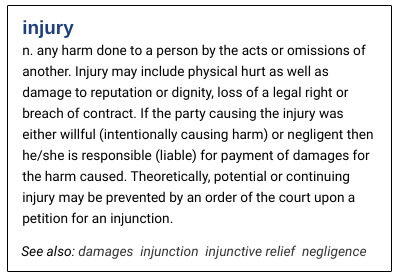
Let's look at injury from the perspective of harm being caused by someone else. Shall we get out our dusty legal definition book? No, we'll go online.
Remember the banners of "cancel rent" and "housing is a human right?"
They are extinct because the pandemic is over and there is no logic to support the cause for free housing.
Cooler minds prevailed in City Hall, but there was a faction who wanted to advance their political future and get their last hurrah by adding in new just cause eviction protections like making injury a prerequisite to eviction.
In a recent article, a tenants' attorney stated that there are countless eviction attempts for trivial lease violations and cites such acts as "leaving a toolbox in the parking lot, having plants on the balcony, storing a bike in the hallway, having a fish tank, having a tenant's kid visit, and having a birthday party for kids."
The attorney goes on to say that in these types of cases, the tenant will assuredly prevail, but "only after spending massive amounts of time and resources defending them."

What say us?
If you've heard from the sea of voices of landlords - hundreds of them braving inclement weather at rallies and waiting hours to speak at city hall meetings - you know that they are not looking to evict for trivial reasons.
Their harrowing stories include losing their retirement savings, becoming disabled because of stress, tenants having blow-out parties at all hours with the landlord unable to do anything about it, and responsible tenants leaving because of the nuisance of neighboring residents who could not be evicted for their menacing behavior.
We did not hear of any gripes about plants on a balcony, kids visiting their friends, and the like.
The squandering of resources?
It is true that eviction cases alleging trivial violations will be tossed out, but how many of these unlawful detainer actions are really filed? Landlords are not in the business of evicting people but in the business of providing housing.
In a frank but balanced article, we recognized the important role of tenants' attorneys and that giving a vulnerable person a hand up is a good thing, but also noted that there are many gambits being used to delay and obstruct an unlawful detainer action. This amounts to clever smoke and mirrors to ratchet up the legal expenses of housing providers who have no access to free legal representation.

If there is a massive expenditure of time and resources staving off an eviction, rest assured that housing providers are fighting an uphill battle defending against frivolous claims and demurrers made by tenants or their counsel.
We've said in many venues that whenever a landlord-tenant dispute crosses our desk, the steadfast goal is to resolve it as quickly and as inexpensively as possible, taking into account time, risk, and attorneys' fees. Our law office never attempts to elongate a dispute.
Whenever we are retained to handle a landlord-tenant dispute and it escalates to the point where we file an eviction action, the matter is ordinarily causing "substantial" and "actual" injury to our clients. If not, our clients would not retain our firm in the first place.
Granted, Bornstein Law can send warning letters for so-called trivial acts, but when we commence an unlawful detainer, rest assured there is substantial and actual damage, so even before Oakland's new just cause requirement goes into effect, we normally have already determined the matter is so significant that it necessitates an eviction.
There will, however, be cases that are not so clear-cut. We would expect some instances when the landlord proves a breach of the lease - through the preponderance of the evidence - but loses the unlawful detainer action because a sympathetic judge or jury believes the owner has not suffered enough to end the rental relationship.
Aside from proving the eviction case, there is now a scale to weigh the landlord's hardship and the desire to keep people housed.
This upends contract law and is concerning to us, but again, we do not see this as a major challenge because we deal with egregious circumstances. By the time a dispute falls into our laps and we file an eviction action, there is clear injury.