
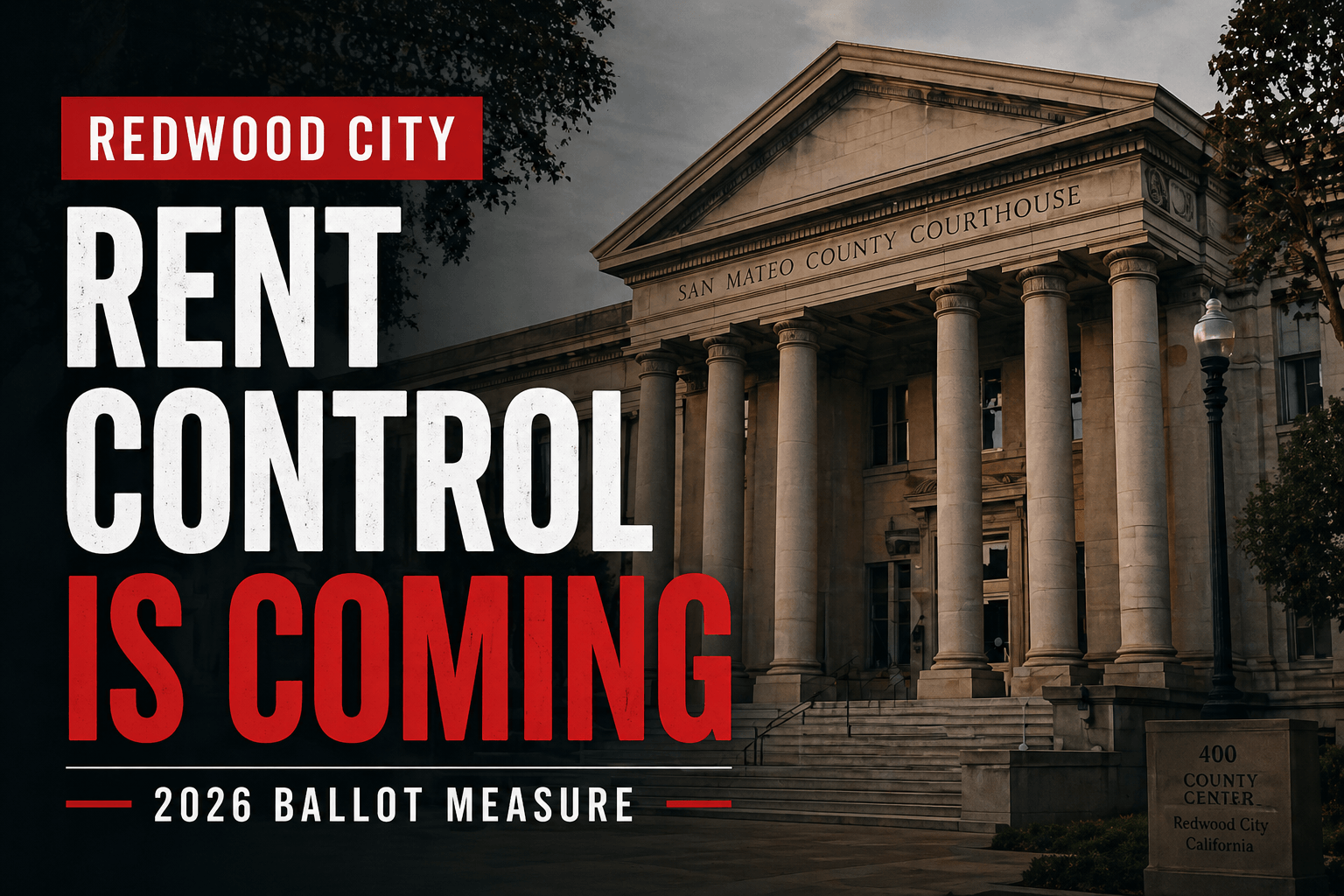
Redwood City Rent Control Returns To The Ballot Box—And It’s More Aggressive This Time
Rent control is back on the table in Redwood City—and this time, tenant groups are aiming higher.
A coalition is working to qualify a November 2026 ballot measure that would significantly expand rent control, tighten eviction rules, and impose new fees on housing providers to fund a city-run regulatory program. If it sounds familiar, it should.
A similar effort failed in 2024 after proponents did not gather the 4,839 valid signatures required to qualify for the ballot. Undeterred, they are trying again—this time with a broader and more ambitious proposal. The newly proposed “Fair and Affordable Housing Ordinance” seeks to establish rent stabilization and appears to be backed by a more organized and better-supported campaign.
Key Provisions
- Rent rollback and caps: Rents would reset to October 2025 levels, with future increases limited to 60% of CPI, capped at 5%.
- Expanded eviction controls: Just-cause protections would be broadened, with no-fault terminations triggering relocation payments of four times HUD fair market rent or $12,000—whichever is greater—with additional amounts for certain tenants.
- New regulatory program: A Rent Stabilization and Tenant Protection Program would be created, funded by annual per-unit fees on housing providers.
- Enforcement mechanisms: The measure would authorize enforcement actions by tenants or the city, including potential damages and attorneys’ fees.
Existing Protections for Redwood City Renters
Tenant protections in Redwood City are layered, combining statewide laws with newer local ordinances aimed at promoting housing stability. Most tenants are covered by California’s rent cap and just-cause eviction requirements under AB 1482, which limit annual rent increases and require a valid reason to terminate a tenancy after a certain period.
Increasingly, however, municipalities across the state are not content with baseline protections and have moved to adopt stricter local controls—or are actively considering them.
Building on AB 1482, Redwood City adopted additional tenant protections effective January 2026 through its Tenant Protection Ordinance (TPO). The ordinance aligns just-cause eviction standards more closely with state law, expands relocation assistance (including higher payments for certain vulnerable tenants), and requires landlords to offer minimum one-year lease terms.
The TPO also provides tenants with a right to return following displacement due to substantial renovations and includes anti-harassment provisions, further regulating landlord conduct during the tenancy.
More Rules. More Fees. More Risk.
Like many local ordinances, the measure works within the boundaries of the Costa-Hawkins Rental Housing Act—for now. Single-family homes, condos, and newer construction would remain exempt only to the extent state law requires, and only as long as those protections remain intact.
And then there’s the funding mechanism: a new Rent Stabilization and Tenant Protection Program, financed by annual per-unit fees on landlords. In other words, housing providers would be asked to bankroll the very system regulating them.
Perhaps most concerning is the enforcement piece. The measure opens the door to tenant and city enforcement actions, including potential damages and attorneys’ fees—raising the stakes for even routine management decisions.
This isn’t Redwood City’s first attempt at rent control, and it likely won’t be the last. But the broader trend is clear: local governments continue to test the limits of state law while shifting more responsibility—and cost—onto housing providers.
For landlords, the takeaway isn’t just about Redwood City. It’s about what’s coming next—and how quickly the rules can change.