
Exit Tax or Strategic Buyout?
The real question for Bay Area landlords: follow the formula—or control the outcome? You’re paying for the vacancy either way.

Removing a tenant through a no-fault eviction isn’t just a legal process. It's a financial event.
When tenants are displaced through no fault of their own, housing providers in the Bay Area need to get out their wallets. Relocation payments are no longer a rounding error, and in cities like San Francisco, Oakland, and Berkeley, they can rival a down payment.
For more on how we got here: → Modest payments designed to help tenants cover moving costs have morphed into five-figure checks that can hold property owners hostage
The Setup
The owner's desire to raise rents or sell a tenant-occupied property vacant is not “just cause” for eviction. Unless you’re dealing with nonpayment of rent, nuisance, or another lease violation, most Bay Area landlords seeking to recover possession are left with two options:
- Follow the statutory path: Pursue a no-fault eviction and pay relocation
- Negotiate a private exit: Enter into a tenant buyout agreement
Vacancy, then, isn’t simply regained—it’s purchased, one way or another. The real question is whether you do it by formula or by design. Let’s take a look at two different pathways toward the same goal.
The Regulated Path: Relocation Payments
Mandated payouts are triggered in no-fault evictions such as owner move-ins, relative move-ins, substantial rehabs, and the permanent withdrawal of units from the rental market, among other events.
The advantage of this carefully choreographed path is predictability—at least on paper. The amounts owed are set by ordinance, and there’s no negotiation required. You pay what’s mandated and proceed. That can be especially useful in strained rental relationships where the parties are, for all practical purposes, incapable of having a productive conversation.
On the other hand, these payments can be cost-prohibitive. The stakes escalate quickly when the tenancy includes individuals deemed vulnerable, such as long-term occupants, seniors, disabled tenants, or households with children.
And while the process is structured, it is far from simple.
Relocation payments come with strict compliance requirements, and landlords must follow the rules to the letter. Missteps in timing, notice, or eligibility can expose housing providers to liability and delay an otherwise valid eviction. There’s also a rigidity to this approach. It is, by design, one-size-fits-all with no adjustment for tenant cooperation, property condition, or the broader context of the tenancy.
Top 3 Relocation Payment Mistakes We See Most Often
1. Getting the Number Wrong
Landlords underestimate what’s owed—especially when protected tenants are involved. A missed category or outdated schedule can turn into underpayment, which may invalidate the notice and force a restart.
2. Mismanaging the Timing
Relocation payments aren’t “pay whenever.” Jurisdictions often require specific installment timing (e.g., partial payment at notice, balance at move-out). Deviating from that sequence can derail the entire process.
3. Treating It Like a Check-the-Box Exercise
Writing the check is not compliance. Landlords still need to:
-
Serve proper notices
-
Meet eligibility requirements
-
Follow through on post-eviction obligations
Skipping steps—or getting sloppy—can expose housing providers to claims, penalties, and delays.
Bottom Line: Relocation payments are deceptively simple. Most problems don’t come from the concept—they come from the execution.

The Negotiated Path: Tenant Buyout Agreements
A voluntary buyout flips the script. Instead of following a fixed formula, you are negotiating a vacancy. Done right, a tenant buyout can be the most efficient path to possession. Done wrong, it can unravel quickly.
Let’s be clear: a properly structured, compliant, and enforceable tenant surrender agreement is far more than “cash for keys.”
The property owner is not simply paying for the tenant to leave—they are paying for finality. That includes known claims, unknown claims, and anything that may arise out of the tenancy down the road.
Consider a tenant who vacates, only to file suit six months later, alleging a respiratory condition caused by mold. Without a properly drafted agreement, that claim is still in play. With a carefully prepared, comprehensive buyout agreement, landlords can significantly mitigate that residual risk.
Yet we routinely see owners—often decisive, Type-A personalities—who assume that handing over a few thousand dollars ends the relationship. It doesn’t. Without a complete waiver and release of claims, the tenancy may be over, but the liability is not.
Pros of Tenant Buyouts
The Value of a Voluntary Vacancy
A useful rule of thumb: Every $1,000 increase in monthly rent can translate to roughly a $100,000 increase in property value. So if a unit is renting at $1,500 but could command $4,000, the math becomes straightforward. Paying $10,000 (plus return of the deposit) to achieve a voluntary vacancy may not just make sense—it may be the best deal on the table. When a reasonable buyout opportunity presents itself, it is often worth serious consideration.
Is it emotionally painful to part with money to a tenant, especially if they are not paying rent or are difficult to deal with? Maybe so, but if it is a smart business decision, we often strongly advise clients to seize the opportunity to see beyond the emotional fray to optimize rental income and long-term financial impact.
Maximum flexibility
The terms, timing, and price are negotiable and, in many cases, landlords will end up paying less than relocation payments triggered in a no-fault eviction. Note that the landlord circumvents the requirements of an OMI/RMI eviction, such as using the unit as their (or a close relative’s) principal place of residence for a continuous period. Nor has the owner been forced to exit the rental market through an Ellis Act Eviction. Moreover, the path of a tenant buyout can have a faster resolution if both sides are motivated.
The optics: Tenant buyout agreements are viewed as a mutual agreement between two parties acting in good faith. It is a “meeting of the minds” to form a contract that both the landlord and the tenant buy into. A voluntary transition, where the tenant participates in the outcome, is often viewed more favorably than a contested eviction—particularly one framed as nuisance or fault-based.
With that said, the flexibility of buyouts comes with its own set of risks. Let’s turn to the potential pitfalls.

Cons of Tenant Buyouts
Breakdown in Communication
Not every tenancy lends itself to negotiation. Many housing providers find themselves in toxic rental relationships, where constructive dialogue is simply not possible. When the landlord and tenant are, for all practical purposes, bulls in a china shop, reaching a voluntary agreement can be an uphill battle.
As a general matter, we often prefer that initial buyout discussions occur directly between landlord and tenant, without attorneys involved. The presence of counsel can escalate tensions, prompt the tenant to seek representation, and shift the dynamic from practical resolution to positional bargaining. Which leads to the next issue.
Escalating Demands
Tenants or their counsel acting in their client's best interest may push for astronomically high payments that are out of whack with reality. We may get a call like, "Mr. Bornstein, thank you for broaching the topic of a buyout agreement with my client. Mr. Smith would be ecstatic to move out of 55 Cranberry Lane in exchange for $200K and a 6-month rent waiver." Something unreasonable like that.
So what may have started as a workable conversation can quickly turn into a protracted and expensive negotiation, and we are unable to reach a deal.
The Conversation Can End Quickly
A voluntary vacancy is exactly that—voluntary, and a tenant is free to decline a buyout outright. They may be perfectly content in their unit and have no interest in leaving—now or ever. And legally, they may be entitled to stay. Absent a valid “just cause” basis for eviction, the tenancy continues.
Once a tenant makes it clear they are not interested in a buyout, the conversation effectively ends. Continuing to press the issue can create risk, particularly in jurisdictions that closely regulate buyout discussions.
In other words, No means no, and it must be respected. If the tenant says that they are very happy living in their studio overlooking People's Park, they are in fact correct. At that point, the strategy must shift. If vacancy is still the objective, landlords need to be prepared to move from negotiation to the regulated path, with all the structure and cost that comes with it.
Compliance Traps: Disclosures and Rescission Periods
Buyouts may feel informal—but in many Bay Area jurisdictions, they are anything but. Cities like San Francisco, Oakland, Berkeley, Alameda, and San Leandro impose strict local requirements on tenant buyout agreements. These often include:
-
Mandatory written disclosures before negotiations begin
-
Specific language advising tenants of their rights
-
Filing requirements with local rent boards
-
Rescission periods that allow tenants to cancel the agreement after signing
These rules are not technicalities but rather conditions of enforceability. A buyout agreement that is out of compliance with the law can be voided entirely or used as a basis for tenant claims, including penalties or attorney’s fees. In other words, a deal you thought was done can come back to life on much worse terms.
This is where landlords often get tripped up. The negotiation may go well, the tenant signs, and money changes hands. Only later does it become clear that a required disclosure was missing or the rescission period was mishandled. The result is uncertainty, delay, and potential liability.
Closing Thoughts
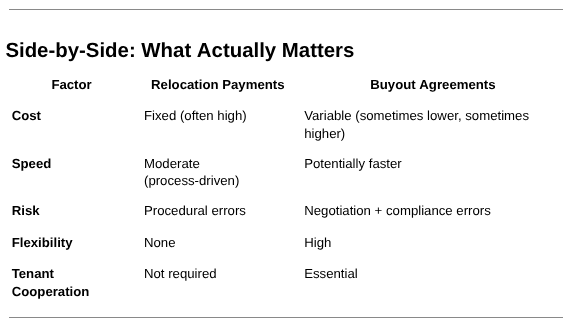
In the Bay Area, vacancy is rarely achieved by accident—it’s the result of a deliberate choice between two very different paths. Relocation payments offer structure and predictability, but at an often steep and inflexible cost. Buyout agreements offer flexibility and potential savings, but introduce negotiation risk and compliance pitfalls. The right approach depends on the tenancy, the tenant, and the landlord’s tolerance for uncertainty, timing pressures, and financial exposure.
This is where experienced counsel matters. Evaluating whether to proceed by formula or by design requires more than a surface-level understanding of the rules—it requires strategy, sequencing, and precision in execution. From properly calculating relocation payments and meeting notice requirements, to structuring enforceable buyout agreements with airtight releases, the margin for error is thin, and the cost of missteps is high. Before committing to a path, landlords would be well served to consult with counsel to ensure the approach aligns with their objectives—and avoids turning a manageable situation into an expensive one.