
Why Small Rent Balances Can’t Trigger Nonpayment Evictions: When California Law Says ‘Not Yet’
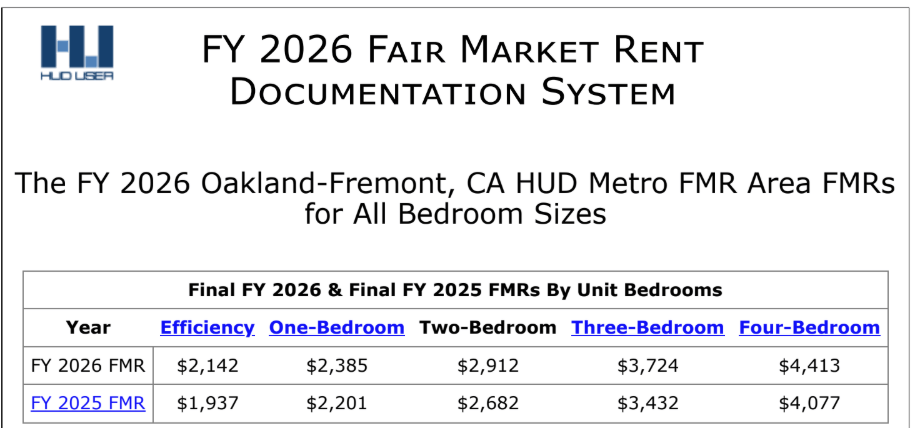
HUD updated its Fair Market Rent (FMR) numbers to reflect changing market conditions. This update is especially consequential for landlords in Berkeley and Oakland.
HUD Fair Market Rent (FMR) is a rent benchmark set each year representing the typical costs to rent a modest, standard-quality rental housing in a specific area, including basic utilities. Luxury features, optional services, and furnishings are not included. Learn more about the methodology used to develop Fair Market Rent values ›
These figures are crucial for HUD housing programs, such as the Housing Choice Voucher (Section 8) program, to establish payment standards, determine rent limits for other HUD-assisted programs, and guide housing agencies on what is considered a “reasonable” rent.
Fair Market Value takes on new meaning for owners of properties in Berkeley and Oakland, where landlords cannot demand rent until the rent owed reaches a certain threshold.
Failure to pay rent is universally a “just cause” reason to evict under state law and local ordinances, and the instrument to start the eviction is a 3-day notice to pay rent or quit. Yet, in Oakland and Berkeley, the 3-day demand notice must reach a high threshold before it can be prepared and served.
In 2024, Berkeley voters gave the thumbs up to Measure BB, a ballot measure that changed Berkeley’s Rent Ordinance in several important ways. Notably, a landlord cannot start an eviction for nonpayment of rent unless the tenant owes at least one month of FMR for a unit of the same size in the Oakland-Fremont metro area. Without this minimum debt threshold being reached, a nonpayment eviction case can be invalid; landlords cannot use nonpayment of rent alone to recover possession of the unit.
Only after the tenant owes at least 1 month of FMR can the landlord proceed with a nonpayment eviction notice, provided that all legal requirements are met.
Likewise, Oakland’s Just Cause for Eviction Ordinance states that “the amount of rent demanded cannot be less than one month of fair market value for a unit of equivalent size in the Oakland metro area, as determined by the U.S. Department of Housing and Urban Development.
What this means for housing providers in those locales is that tenants are required to owe significant back rent before escalating to eviction, but it gets even worse when the tenant has a housing voucher in hand.
Let’s say a Section 8 tenant is renting a one-bedroom in Oakland or Berkeley, where FMR is $2,385. Assume that the tenant’s portion of the rent is 30% of their adjusted monthly income, with Uncle Sam picking up the rest of the tab. The tenant has to pay $715.50. In this example, the tenant has roughly 3 months to pay before rent can be demanded – the amount owed is less than the $2,385 threshold. Once the tenant pays the equivalent of one full month's rent, the tenant can start the debt cycle over again and wait a few more months before paying their share of the rent.
That’s right – there is no incentive for tenants to make timely rent payments because they are insulated from eviction for nonpayment of rent. They don’t owe enough rent just yet. Let's use a hypothetical.
February Rent: The tenant misses their $715.50 payment. The landlord cannot formally demand it with a 3-day notice.
March Rent: The tenant doesn’t pay March rent either. The total owed is only $1,431. The landlord has to wait longer to demand rent because the dollar amount owed doesn’t reach the threshold.
April Rent: Once again, the tenant misses the rent. The total amount owed at this point is $2,146, but the landlord still cannot demand the rent through a 3-day notice because the rent owed isn’t quite high enough yet.
May Rent: Now that the tenant owes $2,862 when May’s rent becomes due, the landlord can demand rent; the tenant owes more than 1 month of FMR. To circumvent the eviction process, the tenant needs only to pay $1,908 and live rent-free for a while longer.
The rule says a tenant can fully breach the lease, but the landlord still has to wait—and pay—until a federal rent number says enough is enough.
The Risk of Getting This Wrong
The risks of getting this wrong are perilous. Filing before the threshold is met can lead to case dismissal, delays of months, attorneys' fees and penalties, allegations of wrongful eviction or harassment. In regulated cities, timing and math matter just as much as notice language.

Bad public policy
We have several quarrels with the public policy of allowing tenants to pile up rent debt until the last minute. Under the FMR rules in Berkeley, a tenant can owe 100% of the rent required by the lease and still be protected from eviction. Housing providers can conceivably lose months of rental income because these rules undermine the basic premise of a lease: rent not paid = enforceable default.
Because eviction is delayed until the FMR threshold is met, landlords are forced to act as involuntary lenders as rent arrears are allowed to accumulate. The HUD-created figure, by the way, is based on a number that housing providers have no control over. Large operators are better able to absorb delayed payments while small, “mom-and-pop” landlords often cannot, so FMR disproportionately harms smaller owners.
Most disturbingly, FMR rules create an incentive for tenants to intentionally pay just enough to stay below this threshold. Partial payments are timed to reset notices and extend arrears. This rewards nonpayment and penalizes compliance. Our offices have witnessed tenants get savvier over time by familiarizing themselves with the law and how to get the upper hand on landlords, and unfortunately, intentionally withholding rent is a glaring example.
Other theories for eviction are on the table
Even if a clever tenant can’t be evicted for nonpayment of rent because they keep their rent arrears below FMR to avoid eviction attempts, other grounds can be used to transition out a problematic tenant. For example, if the tenant is engaged in nuisance behavior, the FMR rules do not prohibit landlords in Berkeley and Oakland from evicting him or her on the theory that they are interfering with the right of neighboring tenants to quietly and peacefully enjoy their homes.
Housing discrimination is still prohibited
Historically, landlords have had a love-hate relationship with Section 8. During times of economic uncertainty, housing providers tend to gravitate towards “steady drip” rent subsidies. This guaranteed paycheck is enough for these landlords to overlook less endearing aspects of housing voucher programs like administrative and bureaucratic hurdles. Yet when there is prosperity and rents are on the uptick, as they are now in the Bay Area, participation in the program becomes less appealing.
Yet when housing providers have to wait months on end to receive the tenant’s share of the rent, it makes even less sense to rent to tenants with a housing voucher. Why would landlords in Berkley and Oakland rent to someone knowing that, conceivably, the unit will not generate steady, predictable cash flow? The answer is no landlord in their right mind would self-select into such a risky relationship, but keep in mind that tenants with government subsidies cannot be categorically denied tenancy based on their source of income. Housing providers can only turn to evidence of the tenant’s ability to pay their portion of the rent. Whether or not the tenant fulfills this obligation promptly is up to the tenant.
To avoid a costly housing discrimination lawsuit, landlords and property managers must welcome all rental applicants and never deny a tenancy based on the fact that the prospective tenant has a housing voucher. The application can be disapproved for other reasons, such as poor landlord references.
To accept partial payments or not?
Since tenants tend to offer partial payments to reset notice timelines and pay just enough to skate by, it seems that one landlording strategy is to not accept rent payments in drips and drabs. Many landlords will refuse to deposit partial payments, and this is a judgment call.
Often, it depends on the size of the partial payment, but landlords are advised to consult with Bornstein Law before accepting partial payments. We are happy to discuss the legal and economic impacts of this. If partial payments are accepted, certainly document the payment in writing, along with a ledger that indicates the balance owed. Consider written non-waiver language with any partial payment, as well.
Bornstein Law strongly opposes FMR thresholds that are unfair, economically distortive, and serve as a deterrent to providing rental housing in Berkeley and Oakland, but we do not write the laws; we only convey the law to our valued clients, colleagues, and followers. However unseemly laws may be, we have to deal with them.