
When a Short-Term Stay Doesn't End

When short-term guests overstay, the issue may stop being about hospitality and start becoming a legal problem. How a simple Airbnb booking can drift into a possession dispute—and what property owners should understand before it does. 

In a hillside Brentwood neighborhood home to celebrities like LeBron James and Fergie, a homeowner rented out a guest house on Airbnb. What began as a perfunctory short-term stay turned into a two-year ordeal.

After an informal extension, the arrangement drifted. The occupant stopped paying rent, Airbnb left the owner in a lurch, and the unsuspecting owner later discovered the unit itself lacked proper permits. What should have been an easy checkout became something far more complicated, one involving unpaid rent, legal exposure, and a prolonged effort to regain possession.

It’s a striking story. But it’s not just a story. Take a look. 


The Moment Control Starts to Slip

Situations like this don’t usually start this way. They begin with a routine booking. A reasonable request. A short extension that feels harmless in the moment.

And then, at some point, the terms stop being clear while the occupancy doesn't. For most Airbnb overstays we have encountered, they are less about sophisticated fraud and more about opportunity. A guest realizes the owner is out of state, for example, and the stay has drifted beyond its original terms, Airbnb has stepped back, and the legal process to remove someone may take time. That combination can invite abuse.

At Bornstein Law, we advise property owners to plan for that possibility—especially in highly regulated rental markets where the margin for error can be thin.

Permission vs. Possession

At the outset, most short-term rental arrangements are just that—short-term. Legally speaking, the relationship is typically a license, not a tenancy.

Think of inviting someone over to watch a Golden State Warriors game. They’re there because you allowed it—for a specific purpose, and for a defined period of time. When the game ends, so does the permission to stay. That's a classic example of a license. 

Airbnb operates on the same premise: defined dates, limited rights, and an expectation that the guest leaves when the reservation ends. The issue is what happens when that premise starts to break down. 


When a Guest Becomes Something More

Short-term rentals are built on defined terms like clear entry, clear exit, and an expectation of control. When those terms hold, the model works. When they don’t, the situation can shift—quickly—from operational to legal.

The shift isn’t always obvious. A stay gets extended. Payment arrangements become less formal. The occupant begins to treat the space less like a temporary stop and more like a place to live. At that point, the analysis changes.

Courts tend to look past labels and focus on reality:

  • how long the person has stayed
  • how much control they have
  • whether the situation resembles a tenancy in substance

Our concern is that what began as permission can start to look like possession.

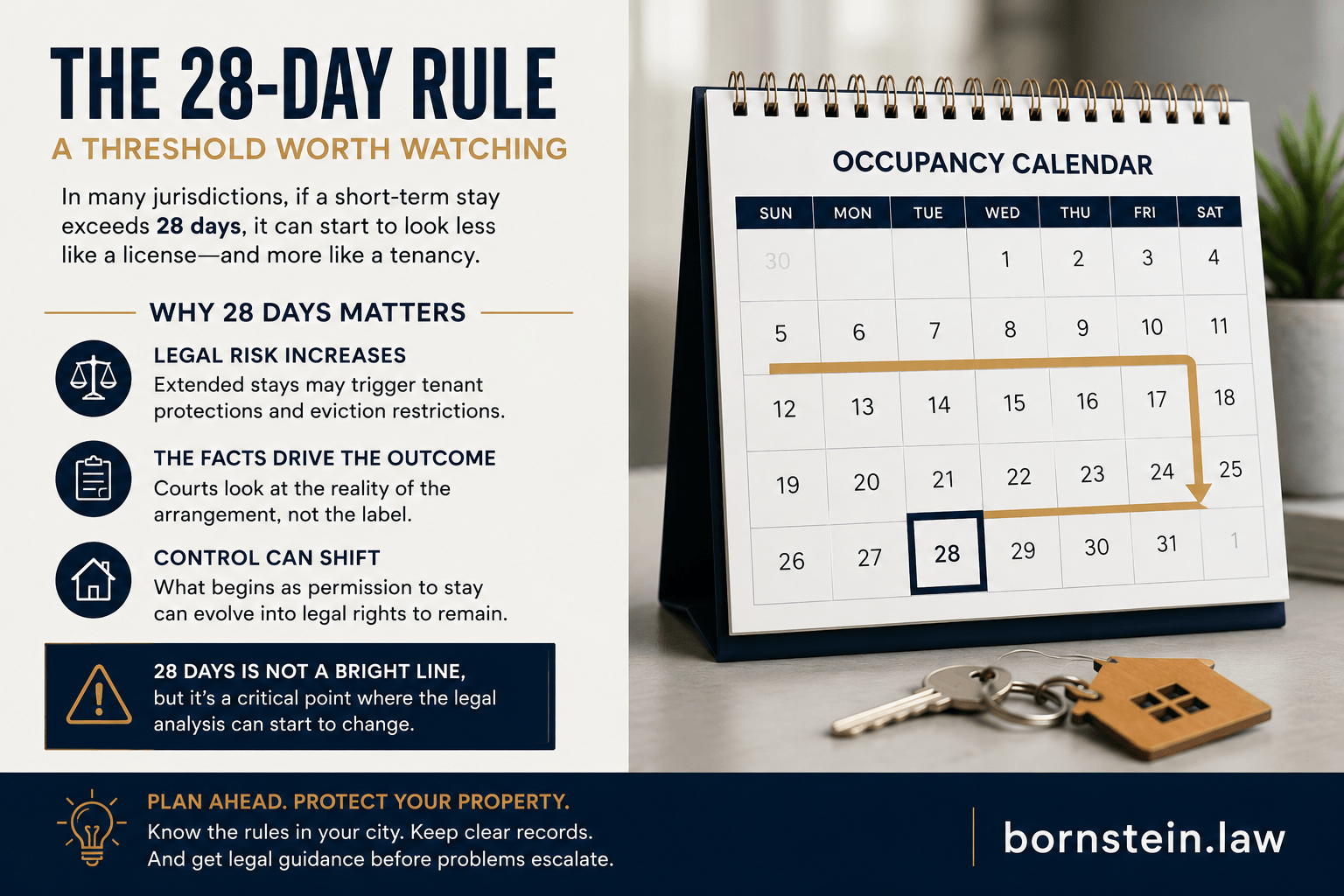
If there’s a number to keep in mind, it’s 28 days. Once a stay approaches or exceeds that window, expectations change, extensions become riskier, and the legal framework may begin to shift.

 

Where the Platform Stops

Platforms like Airbnb are built to facilitate bookings, not to resolve disputes over possession. When everything goes according to plan, they handle reservations, payments, and basic communication. Yet when a guest refuses to leave, their role quickly becomes limited.

  • They cannot remove someone from your property.

  • They do not enforce local eviction laws.

  • And they are not stepping in when the issue becomes a question of who has the right to remain.

  • They cannot remove someone from your property.

The Brentwood situation illustrates the point. Once the stay extended beyond the platform’s involvement, it became a direct legal dispute between owner and occupant. The main point we want housing providers to grasp is that Airbnb can facilitate the stay, but it cannot enforce the exit.

Rules Vary—But the Pattern Doesn’t

Several cities in the Bay Area have strict, specific rules for short-term rentals, also known as SFRs. Key regulations often require the unit to be a primary residence, mandate registration/licensing, and limit unhosted rentals (entire home) to reduce impacts on housing stock.

San Francisco: Requires a Certificate of Registration and restricts rentals to permanent residents who live in the unit at least 275 days a year. Entire-home rentals are capped at 90 days per year.

More →

Berkeley: Permits STRs only if they are the primary residence, the host holds at least $1 million in liability insurance, and the unit was not built or converted to a rental after April 1, 2017.

More →

Oakland: Requires operators to register and remit a 14% Transient Occupancy Tax (TOT) on stays of 30 days or less.


More →


When a Guest Refuses to Leave

When a short-term stay goes sideways, the instinct is to fix it quickly, but that's often when problems multiply. Once a guest refuses to leave, the situation may no longer be about a booking, but about possession. Here are a few practical principles for hosts to follow.


Avoid “self-help” (changing locks, removing belongings)

Even when frustration is justified, taking matters into your own hands can create additional legal exposure. Actions like shutting off utilities, removing property, or physically excluding an occupant may undermine your position and turn a difficult situation into a more expensive dispute.


Document the original terms and any changes

Preserve the original booking details, communications through the platform, payment records, and any extensions or side agreements. In situations where the arrangement begins to drift, the paper trail often becomes one of the most important pieces of evidence in determining how the relationship will be viewed legally.


Re-establish expectations in writing

If the stay extends beyond its original terms, clarify the arrangement immediately and in writing. Defined expectations regarding duration, payment, and checkout can help reduce ambiguity and demonstrate that the occupancy was never intended to become open-ended.


Seek guidance before the situation hardens

Waiting too long can narrow your options. The earlier the situation is evaluated, the easier it is to identify risks, preserve leverage, and determine the appropriate path forward before positions become entrenched.

Once a guest remains in occupancy beyond 30 days, property owners should stop thinking of the situation as a routine short-term rental issue and start evaluating it more cautiously. That does not automatically mean the guest has become a tenant. But it does mean the legal and practical risks have changed.

Owners are often surprised by how quickly a short-term stay can evolve into a possession dispute. Early guidance can help identify the appropriate strategy before the situation becomes more difficult and expensive to unwind.


Screening Still Matters: The Best Eviction Problem is The One That Never Materializes

Many property owners treat short-term rental guests differently from long-term tenants when it comes to screening. That can be a mistake. While the process is necessarily more limited in the short-term rental context, owners should still approach guest selection with the same mindset they would apply to any occupancy arrangement: verify what you can, pay attention to inconsistencies, and trust your instincts when something feels off.

At Bornstein Law, we routinely advise clients that proper tenant screening is one of the most important forms of risk management available to housing providers. The same principle applies here. Last-minute bookings, vague explanations for the stay, requests to move communications off-platform, unusually large groups, or attempts to negotiate around established rules can all be indicators that additional caution is warranted.

Not every problematic stay can be predicted. But thoughtful screening on the front end can significantly reduce the odds that a short-term booking turns into a long-term problem.


Should Owners Use a Short-Term License Agreement?

In many cases, yes. A well-drafted short-term license agreement can be a useful safeguard because it helps define the arrangement from the outset: the occupancy is temporary, the dates are fixed, the permission to stay is limited, and any extensions must be agreed to in writing. It can also establish expectations regarding checkout procedures, overstay consequences, and the revocable nature of the occupancy.

That said, owners should not assume the label alone controls the outcome. Courts often look beyond what the document is called and focus instead on how the arrangement actually unfolds in practice. The longer a stay continues, the more exclusive control the occupant has over the space, and the more informal the relationship becomes, the greater the risk that the situation begins to resemble a tenancy rather than a temporary license.

In other words, a short-term license agreement is best viewed as part of a broader risk-management strategy, not a guarantee.


Once occupancy extends beyond the original short-term framework, owners should proceed carefully and deliberately—not casually.

At Bornstein Law, we assist housing providers in evaluating how these situations are likely to be viewed under California law before missteps compound the problem. That can include assessing whether the occupancy still resembles a temporary license, advising on appropriate documentation and communications, and guiding owners through the lawful process of regaining possession when necessary.

These situations often evolve gradually, but once they harden into formal disputes, the cost, delay, and exposure can increase quickly. Early guidance can make a meaningful difference in preserving options and avoiding unnecessary escalation.

For informed advice, reach out to the firm built for rental housing providers →