
If It Takes 46 Pages to Regulate a Rental Property, Shouldn't Someone Read Them First?

Redwood City presses pause on a sweeping housing initiative while officials seek a fuller understanding of its consequences.
Most people hear the phrase "rent control" and think about limits on rent increases. Redwood City's proposed housing initiative certainly includes that. But city officials recently confronted a different reality: the proposal spans 46 pages and regulates far more than rent.
Evictions. Relocation payments. Buyout agreements. Tenant safety plans. Rights of return. Anti-harassment provisions. Administrative hearings. Enforcement mechanisms. City staffing requirements. Faced with the measure's broad scope, the Redwood City City Council unanimously decided it needed a more complete analysis before taking final action.
That decision highlights a growing challenge facing housing providers throughout California. Increasingly, what begins as a discussion about rent control evolves into a far more comprehensive regulatory framework governing nearly every aspect of the landlord-tenant relationship.
A pause button, not a rejection
As discussed in our earlier article, Redwood City has emerged as the Bay Area's latest battleground for rent control. Supporters of the initiative successfully qualified the measure for consideration, leaving the City Council with limited options under California election law. The council can either adopt the initiative as written or place it before voters.
At its June 8 meeting, however, the council declined to move immediately in either direction. Instead, council members requested additional analysis to determine exactly what they would be asking voters to approve or reject.

The rent control provisions occupy fewer than two pages. The other 44 pages are where the real story begins.

Why This Matters Beyond Redwood City
The most important takeaway from the June 8 meeting is not that Redwood City delayed action on a housing initiative. It is why the council chose to delay it.
Several council members expressed concern that the city had not yet received a complete analysis of the measure's broader impacts. While an earlier study examined the rent control provisions, it did not evaluate the initiative as a whole—including its effects on housing production, city staffing, administration, enforcement, and potential legal obligations. That concern reflects a challenge increasingly facing housing providers throughout California.
Housing regulation no longer consists of isolated rules. Instead, many proposals create entire systems that must be administered, interpreted, enforced, and, in some cases, defended. Rent caps may capture public attention, but the operational realities often involve relocation payments, eviction procedures, buyout regulations, reporting requirements, hearings, oversight mechanisms, and compliance obligations.
For independent housing providers, navigating these frameworks can be especially difficult. Unlike large institutional owners, most landlords do not have compliance departments or in-house counsel dedicated to monitoring regulatory changes.
Whether one supports or opposes the Redwood City initiative, the council's request for additional analysis reflects a simple principle: before adopting a sweeping regulatory framework, policymakers should understand its full consequences. That is a reasonable expectation—and one that housing providers should keep in mind whenever new housing regulations are proposed.
Related Resource: Navigating an Increasingly Complex Regulatory Landscape
The challenges discussed by Redwood City officials are not unique to Redwood City. Across the Bay Area, housing providers face a growing web of regulations governing no-fault evictions, relocation payments, buyout agreements, owner move-ins, substantial remodels, Ellis Act withdrawals, and other tenancy transitions.
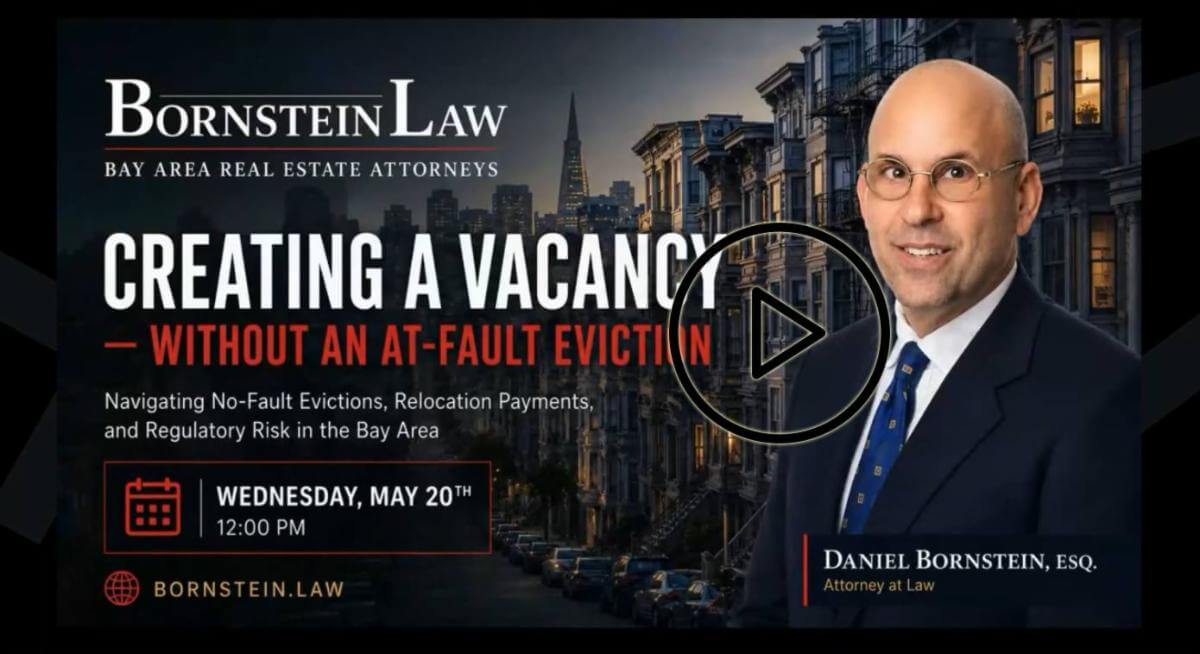
In a recent webinar, attorney Daniel Bornstein explored how these overlapping rules have transformed what were once relatively straightforward property decisions into highly regulated processes requiring careful planning and compliance. Watch the replay below to better understand the legal and practical considerations affecting housing providers throughout the region.
The Conversation Continues
The City Council's decision does not end the debate. The initiative remains alive, and Redwood City must still determine how to proceed after receiving additional analysis.
What the June 8 meeting accomplished, however, was something equally important. It shifted the conversation. The question is no longer whether the measure belongs on the ballot. The question is whether policymakers, voters, and stakeholders fully understand the consequences of a proposal that reaches far beyond rent control.
At Bornstein Law, we have long observed that housing regulations rarely remain confined to a single issue. Measures that begin as discussions about affordability often expand into broader frameworks governing tenancy transitions, relocation obligations, buyout agreements, owner move-ins, eviction procedures, and other aspects of rental housing operations.
Whether this initiative ultimately advances or not, the issues raised in Redwood City reflect a larger trend that housing providers throughout California cannot afford to ignore. Bornstein Law will continue monitoring developments in Redwood City and throughout the Bay Area, helping housing providers understand how evolving regulations may affect their properties, operations, and long-term investment decisions.
For housing providers, staying informed is no longer optional. In today's regulatory environment, it is part of protecting the value and viability of rental housing itself. As local governments continue layering new requirements onto the landlord-tenant relationship, understanding these rules has become more important than ever.