
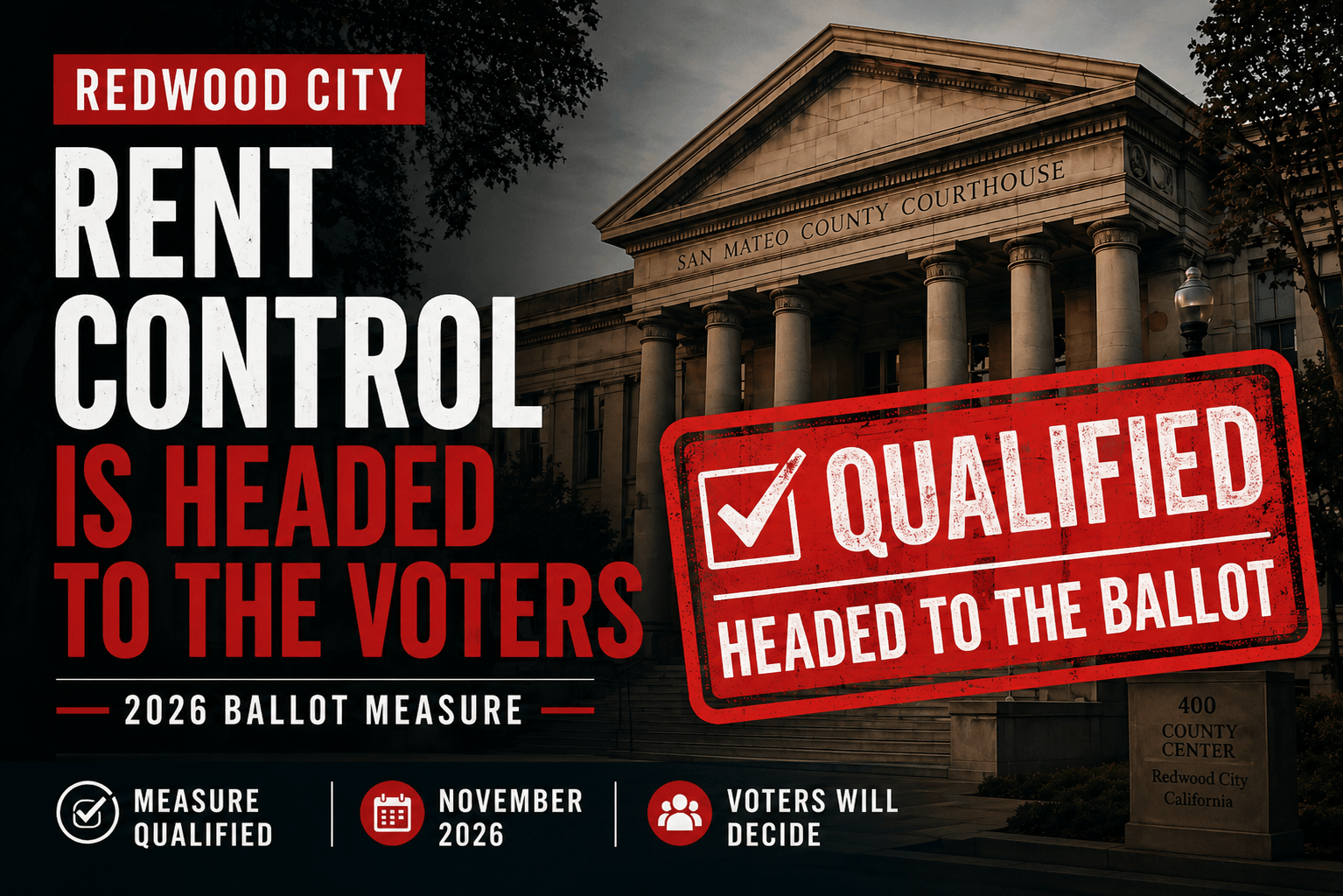
Redwood City Becomes the Next Rent Control Battleground.
Voters will decide to approve a sweeping housing measure that would roll back rents, expand eviction restrictions, and create a new regulatory bureaucracy.

The fight over rent control in Redwood City has officially moved from petition tables to the ballot box.
Supporters of the proposed Fair and Affordable Housing Ordinance have gathered enough signatures to qualify the measure for the November 2026 election, giving voters the opportunity to decide whether to adopt a far-reaching package of rent stabilization and tenant protection measures.
The development is significant not only because of what the proposal would do, but because it follows an earlier unsuccessful effort. In 2024, proponents failed to collect enough signatures to place a rent control initiative before voters. Undeterred, tenant advocates returned with a revised proposal, a broader campaign, and a renewed push to reshape the city's rental housing landscape.
This time, they succeeded.
What the Measure Would Do
If approved, the Fair and Affordable Housing Ordinance would impose several new regulations on rental housing in Redwood City.
Rent Rollback and Future Caps
The measure would roll rents back to October 2025 levels and limit future rent increases to 60% of the Consumer Price Index, with a maximum annual increase of 5%.
Expanded Eviction Restrictions
The proposal would broaden local tenant protections and significantly increase the financial consequences associated with certain no-fault tenancy terminations. In many cases, housing providers would be required to pay relocation assistance equal to four times HUD fair market rent or $12,000, whichever is greater. Additional payments could apply for certain protected or vulnerable tenants.
New Rent Control Bureaucracy
The measure would create a Rent Stabilization and Tenant Protection Program responsible for administering and enforcing the ordinance. Like many local rent control systems throughout California, the program would not be self-funded through general municipal revenues. Instead, annual per-unit fees would be assessed against housing providers to finance the regulatory framework.
Expanded Enforcement Rights
The proposal would authorize enforcement actions by both tenants and the city, including the possibility of damages and attorneys' fees. For housing providers, this means that compliance mistakes could carry substantially greater financial consequences than they do today.
Redwood City Already Has Significant Tenant Protections
The initiative does not exist in a vacuum. Most tenants in Redwood City are already protected by California's statewide rent cap and just-cause eviction requirements under AB 1482. In addition, the city adopted its Tenant Protection Ordinance effective January 2026, layering local requirements on top of existing state law.
Among other provisions, the ordinance expanded relocation assistance obligations, strengthened anti-harassment protections, established additional tenancy protections, and created a right to return following certain substantial renovation projects. The proposed ballot measure would add yet another layer of regulation to an already complex legal landscape.
Why This Matters Beyond Redwood City
Although the measure applies only to Redwood City, the implications extend well beyond city limits. Across California, housing policy debates are increasingly shifting from Sacramento to city halls and local ballot initiatives. When statewide proposals stall or encounter political resistance, tenant advocates often pursue similar objectives through local ordinances and voter initiatives.
Redwood City is simply the latest example.
Whether voters ultimately approve or reject the measure remains to be seen. What is already clear, however, is that local rent control remains an active political issue throughout California and that housing providers can no longer afford to focus exclusively on statewide legislation.
The Takeaway
Redwood City's rent control initiative has cleared its first major hurdle and is now headed to voters. For housing providers, the measure serves as a reminder that today's housing battles are being fought on multiple fronts. Even as statewide proposals rise and fall in Sacramento, local governments continue to test new regulations, expand tenant protections, and increase compliance obligations.
The November election will determine the future of rent control in Redwood City. Regardless of the outcome, the city has only become the latest battleground in California's ongoing debate over rental housing policy and surely not the last.