Bornstein Law
Newsletter Archive
Legal developments, practical guidance, and commentary on the issues shaping California rental housing.
The Votes Are In. The Verdict Is Mixed.
Three Bay Area cities, three rent control measures, and a divided electorate. Redwood City voters rejected an expansion of rent control, while Berkeley and San Pablo approved additional restrictions. We examine the implications for housing providers, including limits on banked rent increases, expanded tenant-organizing rights, relocation obligations, and practical precautions landlords should consider as the regulatory landscape changes.
READ THE NEWSLETTER →Rent Control Is Only the Beginning
Voters in Redwood City, San Pablo, and Berkeley faced ballot measures extending well beyond rent increases, with proposed changes to eviction protections, relocation payments, tenant-organizing rights, and compliance requirements. We examine what each measure would mean for rental property owners, along with new legislation in San Francisco that could make it harder to pursue evictions for unpaid rent.
READ THE NEWSLETTER →Four More Practical Resources for Rental Property Owners
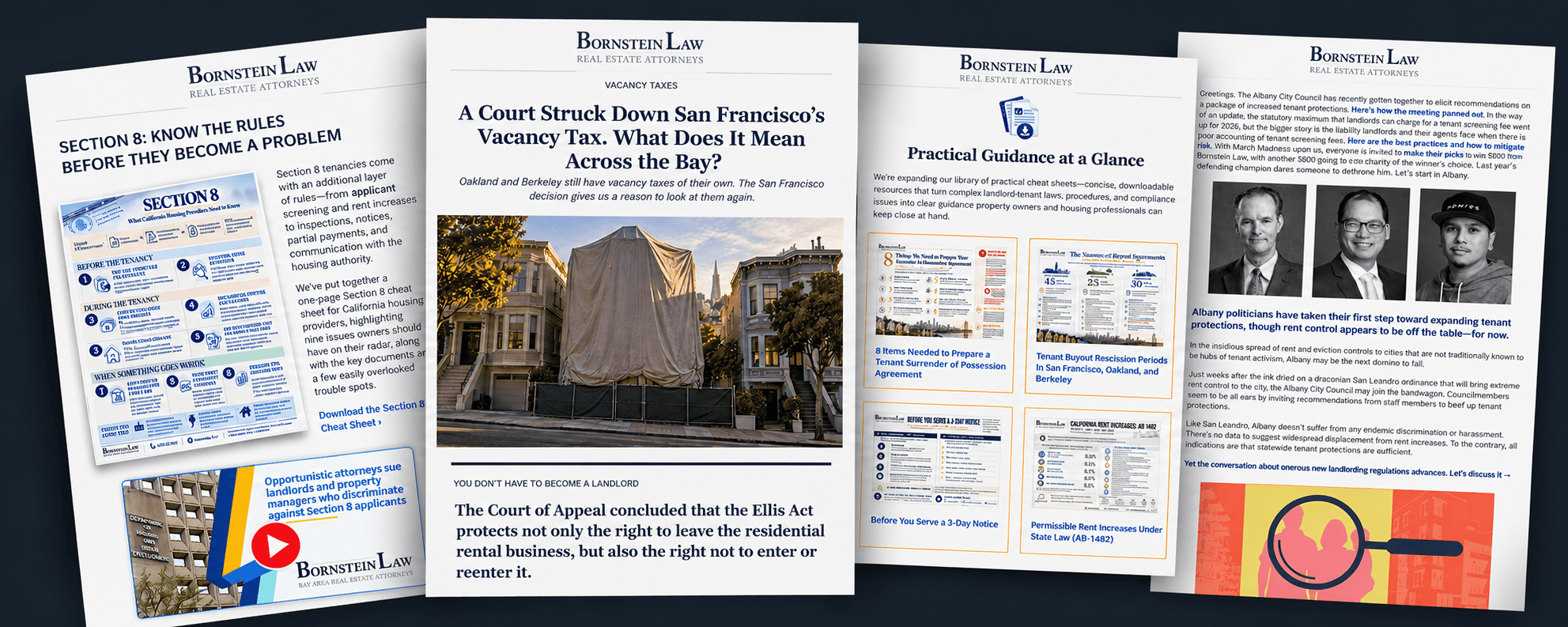
We've expanded Bornstein Law's collection of downloadable cheat sheets with four new resources addressing reasonable accommodations, Section 8 rent increases, authorized occupants, and lease enforcement. Each offers practical guidance to help rental property owners and managers understand their obligations, recognize potential problems, and make more informed decisions.
READ THE NEWSLETTER →Vacancy taxes across the Bay
A California Court of Appeal decision striking down San Francisco’s vacancy tax raises new questions about similar measures in Oakland and Berkeley. We look at what the court said about an owner’s right under the Ellis Act not to enter or reenter the rental business, why the decision does not automatically invalidate other local vacancy taxes, and what it could mean across the Bay.
READ THE NEWSLETTER →When unpaid rent isn’t enough to evict
San Francisco considers tying nonpayment evictions to HUD’s Fair Market Rent, a proposal that could significantly delay action in some tenancies, particularly subsidized housing. We examine how the proposed threshold would work and look more broadly at Section 8, including screening, rent increases, inspections, notices, and California’s source-of-income protections.
READ THE NEWSLETTER →
When utility billing becomes a landlord-tenant problem
RUBS may offer a practical way to allocate utility costs in master-metered buildings, but local rent-control and disclosure rules are making these systems increasingly complicated. We examine the growing scrutiny of utility billing, take a closer look at San Francisco’s rising eviction filings, and introduce new practical guides covering tenant buyouts, 3-day notices, and rent increases.
Pets, pied-à-terre rules, and where someone really lives
California lawmakers revisit pets in rental housing with SB 1296, prompting a broader look at pet policies, assistance animals, and nuisance issues. We also examine New York City’s new pied-à-terre surcharge and its parallels in the Bay Area, including San Francisco Rent Board Rule 1.21 and the consequences when a rent-controlled unit is not a tenant’s principal residence.
READ THE NEWSLETTER →Tenant buyouts: the numbers and the negotiation
Tenant buyout agreements are gaining momentum in San Francisco, with some owners paying substantial sums to obtain a voluntary vacancy. We look at the latest buyout numbers, why these agreements can make economic sense, and how understanding what a tenant actually wants can sometimes produce a better deal than simply offering more money.
READ THE NEWSLETTER →
Section 8, work-from-home fees, and when guests become tenants
A new federal lawsuit asks whether California can require housing providers to participate in the Section 8 program, raising questions about the state’s source-of-income protections and what could change if the challenge succeeds. We also examine work-from-home fees, revisit nuisance issues, and look at the risks when a short-term rental guest stays long enough to acquire potential tenancy rights.
The Strategy Behind the Rent Increase
As AB 1482's 15-year exemption expires for more properties, housing providers face important decisions about rent adjustments and long-term tenant relationships. We examine why the largest legally permissible increase isn't always the strongest business strategy, and how balancing immediate financial considerations with tenant stability can lead to better long-term outcomes.
READ THE NEWSLETTER →When Does a Difficult Tenant Become a Nuisance?
When do repeated lease violations and neighbor complaints become a legally significant nuisance? We examine why patterns of behavior often matter more than isolated incidents, the warning signs housing providers should recognize, and the importance of addressing problems before they escalate. We also explore why maintaining clear professional boundaries, rather than making endless exceptions, is essential to effective property management.
READ THE NEWSLETTER →Following the Digital Breadcrumbs
Can a tenant's social media activity help uncover lease violations? We explore how online posts may provide useful clues when investigating nuisance complaints, unauthorized alterations, occupancy issues, and property damage. This edition also previews our webinar on building stronger nuisance cases through effective documentation and examines Oakland's updated relocation payment requirements.
READ THE NEWSLETTER →
General guidance is a starting point.
Your circumstances are what matter.
Every rental property, tenancy, and legal dispute comes with its own set of facts. What works for one housing provider may not be appropriate for another.
Bornstein Law helps property owners and managers understand how California's complex rental housing laws apply to their particular circumstances—and develop a practical course of action.
SCHEDULE A CONSULTATION →