
Are San Francisco Evictions Really Surging?
Eviction lawsuits have increased sharply in San Francisco. But put those filings in context—and distinguish an eviction lawsuit from an actual eviction—and the numbers tell a more complicated story.
Recent reporting suggests that evictions are on the rise in San Francisco.
The numbers certainly deserve attention. The San Francisco Rent Board has recorded a substantial increase in eviction notices. According to Superior Court records obtained by The Frisc, 3,654 unlawful detainer lawsuits were filed in 2025. The San Francisco Sheriff's Office also reported 924 lockouts, up from 819 the previous year.
But before concluding that San Francisco is experiencing an eviction surge, there is an important question to ask: What exactly are we counting as an eviction?
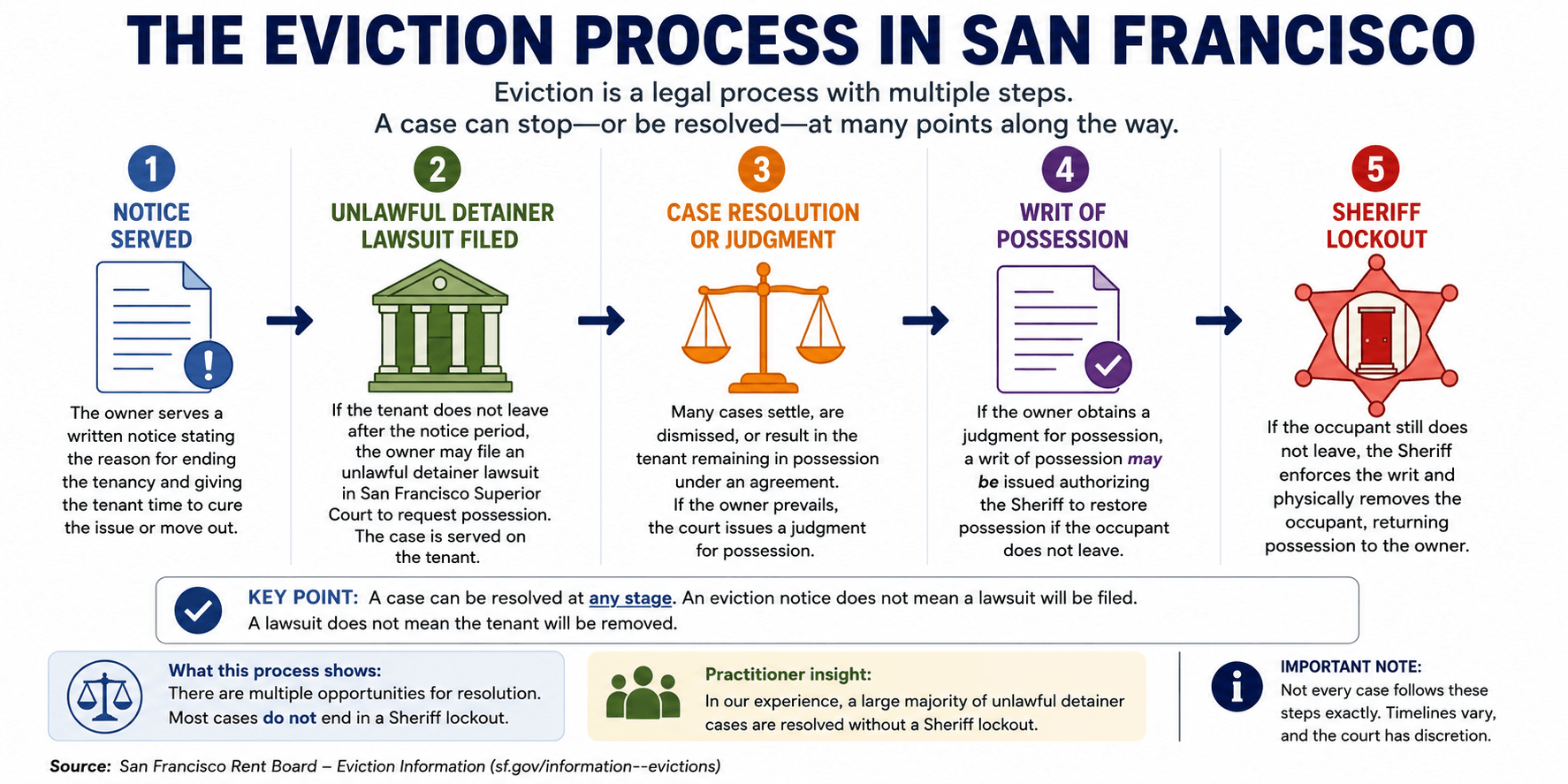
An eviction notice, an unlawful detainer lawsuit, and a Sheriff lockout represent different stages of a legal process. Treating them as interchangeable can produce a very different impression of what is actually happening in San Francisco's rental housing market.
“A lawsuit is not an eviction. And an increase in lawsuits does not necessarily mean an eviction epidemic.”
3,654 Eviction Lawsuits. Out of How Many Rental Households?
Raw numbers can sound enormous without a denominator.
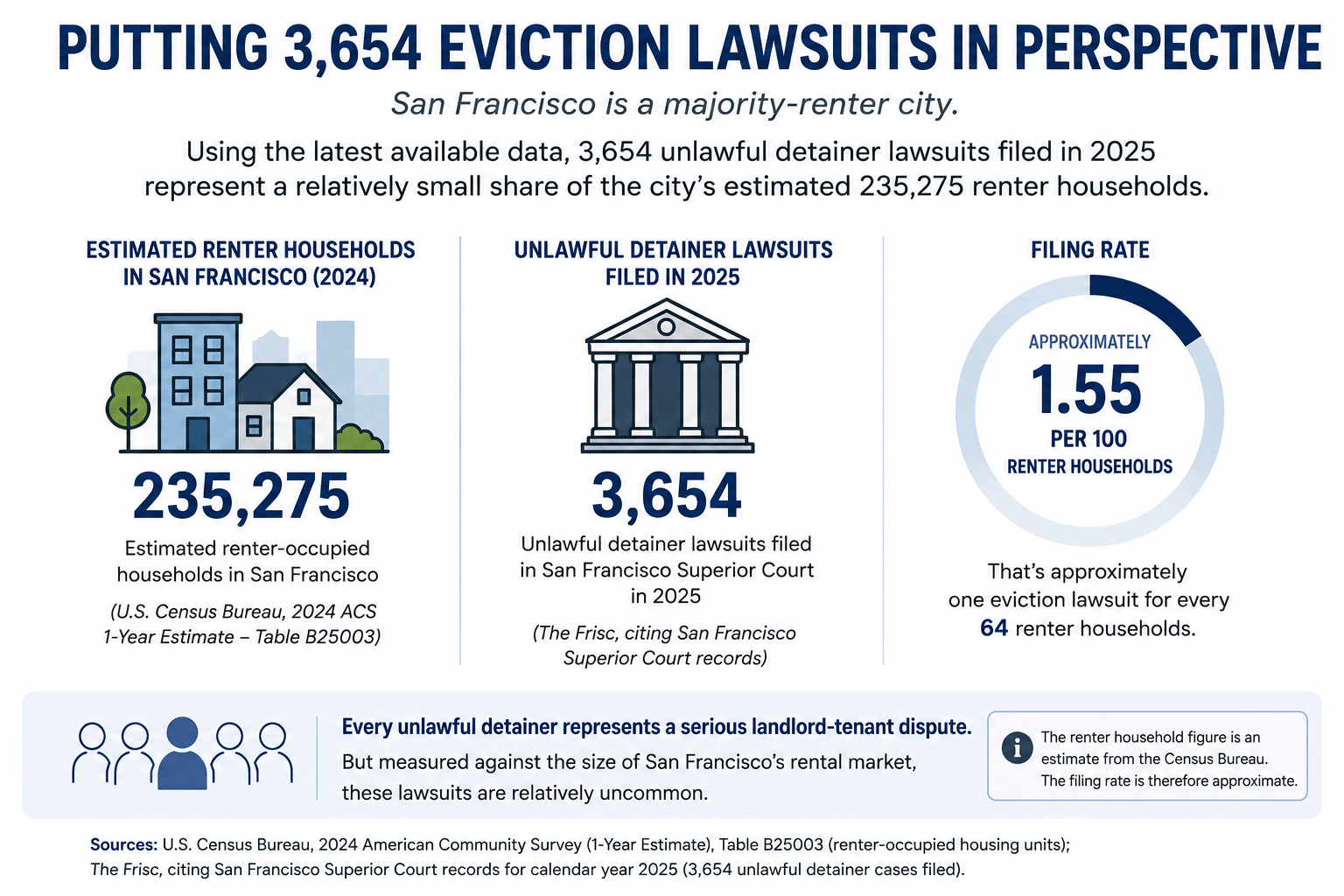
San Francisco is a majority-renter city. According to the U.S. Census Bureau's 2024 American Community Survey 1-Year Estimate, the city had an estimated 235,275 renter-occupied households, representing roughly 63 percent of occupied housing units.
Against that rental population, the 3,654 unlawful detainer cases reported for 2025 amount to approximately 1.55 eviction lawsuits for every 100 renter households.
Put another way, that is approximately one eviction lawsuit for every 64 renter households in San Francisco.
That is not an insignificant number. Every unlawful detainer represents a dispute serious enough to reach the courts. But putting the raw number against the size of San Francisco's rental market provides important context for headlines suggesting widespread eviction.
“Raw eviction numbers can sound enormous. The denominator tells you whether they actually are.”
Filing an Eviction Lawsuit Is Not the Same as Evicting Someone
This distinction may be obvious to attorneys and housing professionals, but it is frequently blurred in public discussions about eviction.
An unlawful detainer is the court process an owner generally must use when seeking possession after the required notice has expired. San Francisco itself describes eviction as a legal progression that typically involves a written notice, an unlawful detainer lawsuit, a court judgment and, when necessary, enforcement by the Sheriff.
The filing therefore tells us relatively little about how the dispute ultimately ends. A tenant may pay amounts owed, the parties may settle, a lease violation may be cured, or an owner and tenant may negotiate terms permitting the tenancy to continue. Other tenants voluntarily relocate. Some cases are dismissed, while others proceed to judgment and possession.
In our experience representing rental property owners, many unlawful detainer cases are resolved without a Sheriff ever arriving at the property to physically remove the tenant. National eviction researchers similarly distinguish between eviction filings and completed evictions because commencement of a court case does not establish its ultimate outcome.
That distinction becomes particularly important when discussing San Francisco's 3,654 cases as evidence of an "eviction surge."
What About the 924 Sheriff Lockouts?
Sheriff lockouts get much closer to what most people ordinarily envision when they hear the word "eviction." Once the court has authorized possession and the occupant has not left, the Sheriff may enforce the writ and restore possession of the property.
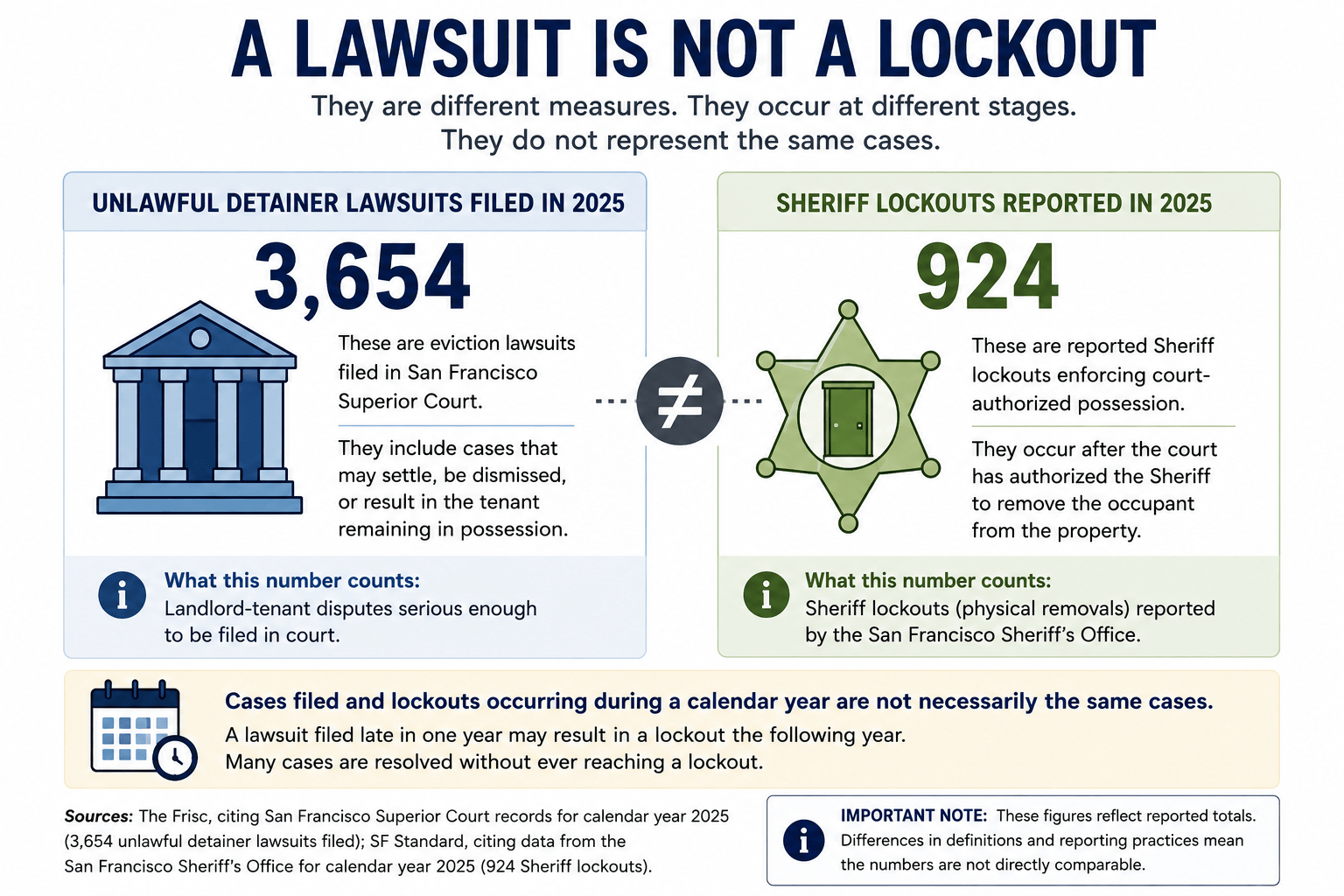
San Francisco recorded 924 Sheriff lockouts in 2025, compared with 819 in 2024. That increase is real, but the relationship between the lockout figure and the 3,654 unlawful detainer filings requires some care.
They do not represent a cohort of the same cases. An unlawful detainer filed late in one year may produce a lockout the following year, and many cases are resolved without reaching that stage. We therefore cannot simply subtract 924 from 3,654 and conclude that the remaining cases did not result in an eviction.
What the numbers do illustrate is the danger of treating court filings and physical removals as synonymous. Thousands of landlord-tenant disputes entered Superior Court in 2025, while fewer than 1,000 Sheriff lockouts were reported during the same calendar year.
Put San Francisco Alongside Other Rental Markets
Another way to evaluate eviction activity is to account for the size of the rental population rather than comparing raw case totals.
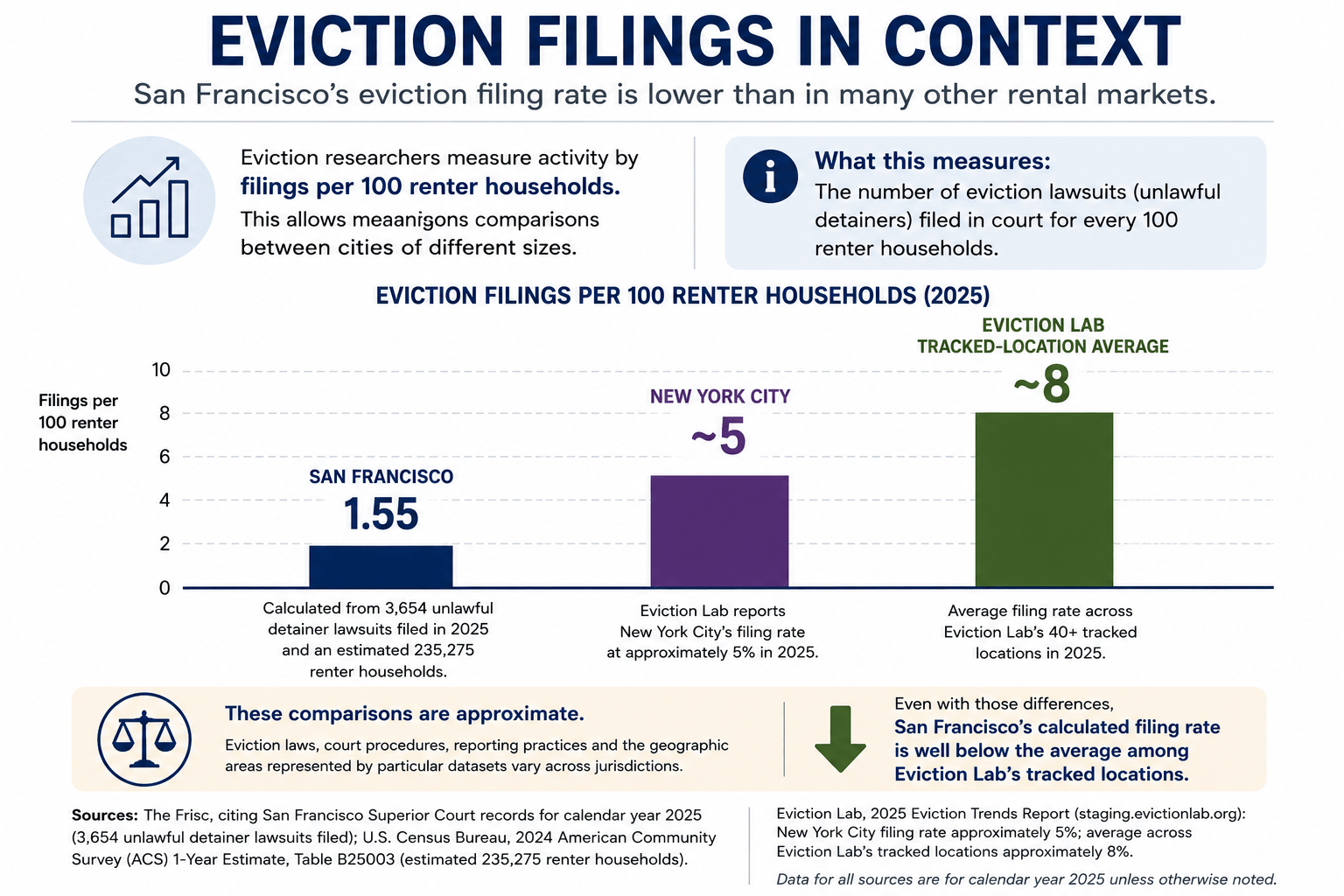
Eviction researchers commonly calculate a filing rate: the number of eviction lawsuits filed for every 100 renter households. Using the 3,654 San Francisco cases reported for 2025 and the latest available Census estimate of renter households, the city's calculated filing rate is approximately 1.55 per 100 renter households.
For perspective, Eviction Lab reported an average of approximately 8 filings per 100 renter households across the locations it tracked in 2025. New York City—another expensive rental market with extensive tenant protections—had a filing rate of approximately 5 per 100 renter households.
Cross-city comparisons deserve caution. Eviction laws, court procedures, reporting practices, and even the geographic areas represented by particular datasets differ. These figures should therefore be viewed as context rather than a precise ranking of cities.
Even with those qualifications, the disparity is notable. San Francisco can experience an increase in eviction litigation while still maintaining a relatively low filing rate compared with many of the rental markets tracked by Eviction Lab. Those two things can be true at the same time.
The Bay Area Numbers Add More Context
We do not have to look across the country to put San Francisco's numbers in perspective.
The Bay Area Housing Finance Authority examined eviction lawsuits throughout the nine-county Bay Area. For July 2023 through June 2024, San Francisco had an eviction-lawsuit rate of approximately 1.2 percent, tied with Sonoma County for the second-lowest rate in the region. Only Marin County, at 1.1 percent, was lower.
That finding is particularly interesting given San Francisco's extensively regulated rental housing system. The city has just-cause eviction requirements, substantial local procedural requirements and publicly funded legal assistance for tenants facing eviction.
Those protections may help explain why increased litigation does not necessarily translate into an equally dramatic increase in completed evictions. They also underscore a reality familiar to San Francisco property owners: commencing an eviction here is rarely a casual undertaking.
What Is Actually Driving the Cases?
There is another reason to be cautious about attributing increased eviction activity primarily to rising market rents.
The theory is straightforward: as market rents rise, the spread between a long-term rent-controlled tenancy and market rent grows, potentially creating a greater financial incentive for an owner to recover the unit. That dynamic may exist in some cases, but the aggregate filing numbers do not tell us why individual lawsuits were brought.
Tenant advocates themselves report that nonpayment of rent represents a substantial portion of the eviction cases they encounter. The Eviction Defense Collaborative has estimated that payment disputes account for as many as 80 percent of the cases it sees.
That figure should not be extrapolated to mean that 80 percent of all San Francisco eviction lawsuits involve nonpayment. But it does complicate any suggestion that increased eviction activity can primarily be explained by owners seeking to replace long-term tenants with higher-paying renters.
Other unlawful detainer cases arise from alleged nuisance activity, lease violations, unauthorized occupants and other breaches of rental agreements. These disputes all enter the same legal system and ultimately become part of aggregate filing statistics despite arising from very different circumstances.
Understanding why cases are being filed therefore matters almost as much as knowing how many cases there are.
Is This a Surge—or a Return Toward Normal?
The historical comparison adds another layer to the discussion.
The pandemic profoundly disrupted California's eviction system. Emergency protections, eviction moratoria, rental assistance programs and court disruptions drove eviction activity to unusually low levels. As those protections expired and normal court operations resumed, filings increased.
The Bay Area Housing Finance Authority's regional study provides a useful pre-pandemic benchmark. For July 2018 through June 2019, San Francisco's eviction-lawsuit rate was approximately 1.2 percent. For July 2023 through June 2024, it was again approximately 1.2 percent.
By that particular measure, San Francisco's post-pandemic eviction litigation had returned to approximately its pre-pandemic rate.
The separately reported 2025 Superior Court figure suggests that filing activity increased further, although the datasets and reporting periods are not identical and should not be treated as a precise apples-to-apples comparison.
There has clearly been an increase worth watching. But there is a meaningful difference between saying eviction lawsuits have risen substantially from pandemic-era lows and saying San Francisco is experiencing an historically extraordinary level of eviction.
The available data do not necessarily tell the same story.
A More Legalized Rental Housing Environment
Perhaps the more consequential story for rental property owners is not simply whether eviction filings are rising, but what those numbers say about the environment in which tenancy disputes are now being resolved.
San Francisco has an extensively regulated rental housing system. Tenants facing eviction have access to legal representation and a substantial network of advocacy organizations. Notices and service requirements are scrutinized, state law intersects with local rules, and procedural errors made at the beginning of a case can create significant problems later.
For owners, there is consequently little room for improvisation. The legal basis for termination, the wording and service of the notice, supporting documentation, communications between the parties and the procedural requirements applicable to the particular tenancy can all influence the eventual outcome.
The existence of thousands of unlawful detainer filings therefore tells us something important: thousands of serious landlord-tenant disputes are entering San Francisco's legal system.
It does not, on its own, tell us that thousands of tenants are being physically removed from their homes.
“The headline tells us how many cases entered the system. It tells us remarkably little about how those cases ended.”
Numbers Need Context
Eviction is consequential, and for renters who lose their housing the disruption can be profound. Putting eviction statistics into context does not diminish that reality.
But housing policy discussions are better served when we understand what the numbers actually measure. An eviction notice may never produce a lawsuit. A lawsuit may be settled or dismissed rather than proceed to judgment. And even cases in which an owner ultimately recovers possession do not necessarily culminate in a Sheriff physically removing a tenant.
So are San Francisco evictions really surging?
Eviction activity has unquestionably increased from recent lows. Yet when the number of lawsuits is measured against the size of San Francisco's rental market, considered alongside regional and national data, and distinguished from actual Sheriff lockouts, the suggestion that eviction itself has become commonplace is much harder to support.
Perhaps the more accurate story is that more landlord-tenant disputes are entering San Francisco's highly regulated legal system—and the headline numbers alone tell us remarkably little about how those disputes ultimately end.
Navigating San Francisco's Eviction Process
For rental property owners, the lesson is not simply that eviction statistics require context. Individual cases do, too. The grounds for recovering possession, the notices that must be served, local requirements and the strategy employed before litigation begins can materially affect the outcome.
Bornstein Law represents Bay Area rental property owners in unlawful detainer actions and the broader range of landlord-tenant disputes that can lead to them. We help owners evaluate their options, navigate San Francisco's complex regulatory environment and pursue practical solutions when a tenancy has become difficult or unsustainable.