
The Trouble With RUBS: When Utility Billing Becomes a Landlord-Tenant Problem
As California regulators scrutinize how owners divide shared utility costs, a practical solution for master-metered buildings is creating new legal and compliance risks.

For many rental property owners, Ratio Utility Billing Systems — commonly known as RUBS — emerged as a practical solution to an old problem.
Many older multifamily buildings were constructed with master-metered utilities. There may be one water bill for an entire property, for example, with no practical way to determine precisely how much water was consumed by the occupants of each individual unit.
RUBS attempts to solve that problem by allocating the building's utility costs among residents according to a formula, typically taking into account factors such as the number of occupants, size of the unit, or number of bedrooms.
The concept is understandable. Increasingly, however, RUBS is becoming a problem.
The problem isn't going away with the utility bill
The Los Angeles Times recently chronicled growing resistance among renters who receive utility bills calculated through RUBS. Some tenants have seen their monthly charges increase substantially without being able to determine precisely why.
That has led to an unusual form of tenant activism: residents refusing to pay their allocated utility charges until owners or property managers produce the underlying master bills and explain the calculations.
The controversy highlights a fundamental weakness of RUBS. Unlike a separately metered utility, the amount appearing on a tenant's bill does not necessarily reflect that tenant's actual consumption. A resident who spends much of the month away from home may still receive a substantial bill because the charge is derived from the building's overall consumption and an allocation formula.
For rental property owners, this creates fertile ground for disputes. And California regulators are paying attention.
Calling something a utility charge does not necessarily remove it from rent regulation.
When Utility Charges Intersect With Rent Regulation
Calling something a utility charge does not necessarily place it outside the rules governing rent.
In rent-regulated jurisdictions, separately imposed utility charges may affect the amount a tenant is considered to be paying for housing and can implicate limitations on rent increases. Much depends on the rental agreement, when and how the charge was imposed, whether utilities were previously included in rent, and the particular state and local rules governing the property.
For owners, the practical lesson is straightforward: a new or increased utility charge should not automatically be treated as an expense that can simply be passed through to the tenant. Before changing how utilities are billed, owners should determine how the charge will be treated under the applicable rent-control framework.
Bay Area Jurisdictions Are Already Restricting RUBS
For Bay Area rental property owners, the debate over RUBS is not theoretical. Several local jurisdictions already restrict how owners of regulated properties may allocate utility costs among tenants.
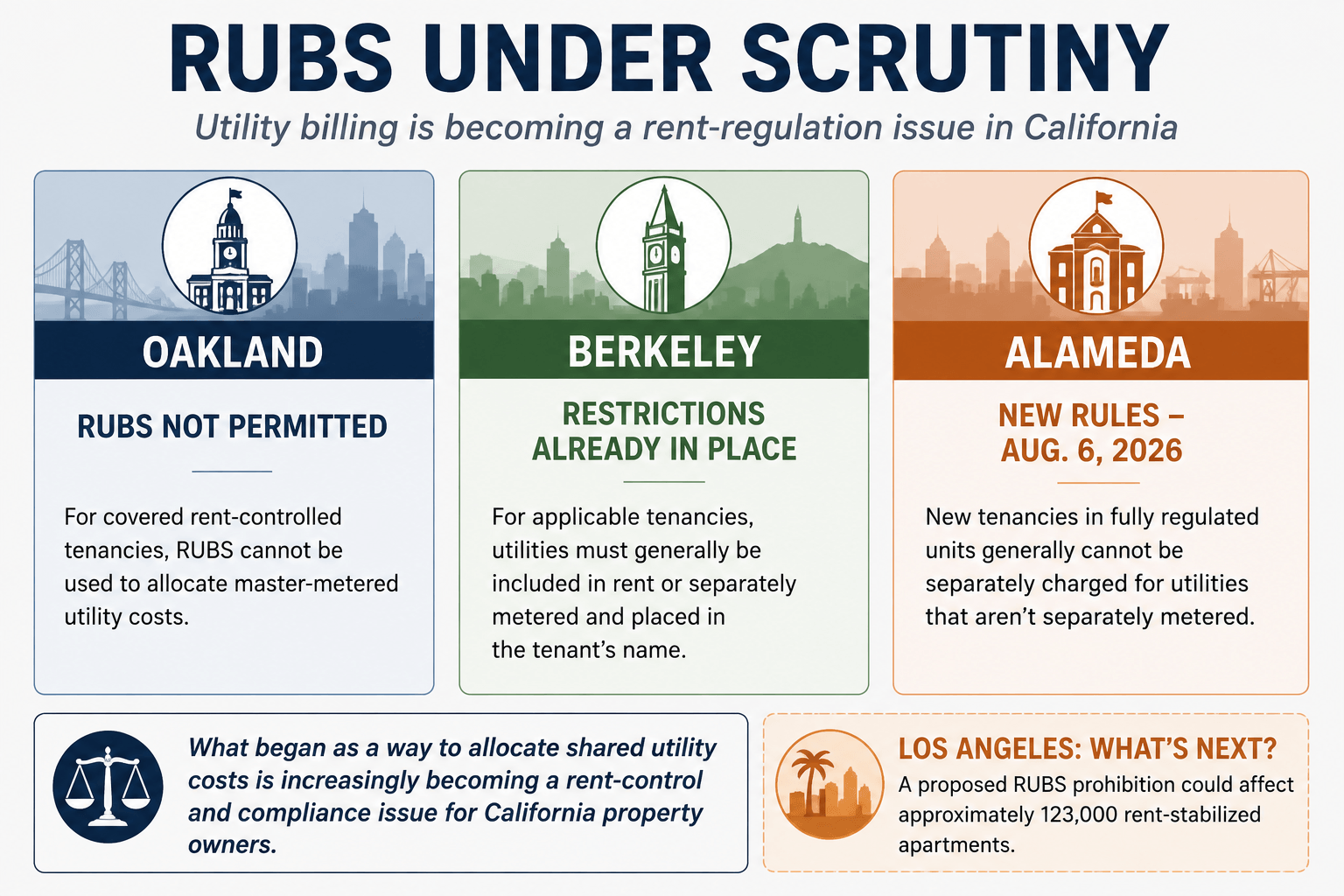
Oakland does not permit RUBS for covered rent-controlled tenancies. Owners cannot simply divide a master-metered utility bill among residents using an allocation formula and treat the resulting amount as a separate utility obligation.
Berkeley has also placed significant restrictions on the practice. For fully covered units with tenancies beginning on or after February 6, 2024, utilities generally must either be included in the tenant's base rent or separately metered, with the tenant responsible for establishing the utility account in the tenant's own name. In practical terms, that leaves little room for a conventional RUBS arrangement as a separate monthly charge.
Alameda is the latest Bay Area jurisdiction to move in this direction. Ordinance 3407 took effect August 6, 2026. For new tenancies in fully regulated units, landlords generally may no longer separately charge tenants for utilities that are not separately metered. Existing tenancies are treated differently, with the city's Rent Program establishing procedures for bringing affected arrangements into compliance.
The details vary from city to city, but the direction is increasingly clear: owners should not assume that a utility-allocation practice permissible at one property will be permissible at another property a few miles away.
Los Angeles may be heading in the same direction
Los Angeles is considering its own response.
The Los Angeles Housing Department has recommended prohibiting RUBS in rent-stabilized housing. Approximately 19% of the city's rent-stabilized apartments are estimated to be master-metered, potentially affecting roughly 123,000 units.
Meanwhile, some Los Angeles tenants have organized what amount to RUBS strikes, withholding utility payments while demanding access to the underlying bills and calculations. The dispute has therefore moved well beyond an argument over how to divide a water bill.
It has become another front in the larger debate over what constitutes rent, what housing costs must be disclosed, what expenses owners may pass through to residents, and how much documentation tenants are entitled to receive.
Owners have a legitimate problem, too. None of this changes the underlying dilemma that led owners to RUBS in the first place.
Someone has to pay the utility bill.
In a master-metered building, absorbing utilities into rent means an owner assumes the risk of increasing utility rates and consumption. It also gives an individual resident little financial incentive to conserve because additional usage may not directly increase that resident's housing cost.
And consumption can vary dramatically from one household to another. One resident may be away from home for most of the day. Another may have several occupants at home, appliances running, laundry being done, electronic devices charging, and heating or air conditioning operating for hours at a time.
Yet in a master-metered building, the utility company sees only the building. That is precisely the problem RUBS was designed to solve.
We've encountered this problem before
Earlier this year, a Walnut Creek rental listing generated considerable attention after an owner advertised a furnished one-bedroom ADU for $3,250 per month, including utilities and Wi-Fi, but imposed an additional $200 monthly charge if the tenant worked from home.
The owner's economic concern wasn't difficult to understand. Someone occupying a unit throughout the day may consume more electricity, heating, air conditioning, water, and internet service than someone who leaves for work every morning.
But charging according to a tenant's lifestyle creates a different problem.
As Daniel Bornstein observed at the time:
“A tenant rents a home—not a schedule. Working from home is simply one way of exercising the right to occupy the premises.”
— Daniel Bornstein
The difficulty quickly becomes apparent. Does a work-from-home fee apply to someone who works remotely once a week? What about a retiree who spends most of the day at home? A stay-at-home parent? A student taking online classes? Someone who simply likes the air conditioning running all afternoon?
If the owner's concern is utility consumption, the more logical approach is to charge for utility consumption rather than attempting to price a tenant's daily routine.
Separately metered utilities accomplish exactly that. Residents pay for what they actually consume. But that brings us right back to the problem.
What happens when you can't measure individual consumption?
Retrofitting an older multifamily building with individual meters can be expensive, technically difficult, or impractical.
RUBS was intended to occupy the space between two imperfect alternatives: owners absorbing increasingly expensive utilities into rent, or undertaking costly modifications necessary to measure every household's actual consumption.
The economic rationale isn't frivolous. The problem is that an allocation formula still isn't a meter.
A formula based upon occupants, bedrooms or square footage may produce a reasonable approximation. But it cannot tell an owner whether one resident spent three weeks traveling while another household ran appliances, electronics and climate control around the clock.
That is what makes the debate more complicated than simply declaring that owners shouldn't pass utility expenses through to tenants. The expense is real. The consumption differences are real. Measuring who actually caused the expense is the problem.
Transparency is becoming difficult to avoid
Even where RUBS remains permissible, owners should expect increasing scrutiny of how the numbers are calculated. If a tenant receives a bill for $175 in water, sewer and garbage charges, it is reasonable to anticipate the next question:
How did you arrive at $175?
An owner who cannot readily answer that question — or whose third-party billing provider cannot document the calculation — is inviting a dispute.
That does not necessarily mean the charge is improper. It means that an opaque billing system is increasingly difficult to defend in an environment where regulators and tenants are looking more closely at mandatory charges imposed in addition to stated rent.
A practical solution can become a legal problem when the regulatory environment surrounding it changes.
RUBS should no longer be treated as bookkeeping
For rental property owners, that may be the most important lesson.
RUBS once could be viewed largely as an operational decision: determine the building's utility expense, select an allocation methodology, engage a billing provider, and divide the cost among residents.
That approach deserves reconsideration.
Before implementing, modifying or enforcing a utility allocation arrangement, owners should understand what their rental agreements actually authorize, whether the property is subject to state or local rent limitations, how the jurisdiction treats utility charges, whether changes to those charges could constitute a rent increase, and what documentation should be maintained and made available to residents.
Owners should be particularly cautious about introducing new utility charges during an existing tenancy or attempting to recover unpaid RUBS charges without first determining whether those charges were lawfully imposed.
The regulatory direction is becoming difficult to miss. Oakland and Berkeley already restrict RUBS, Alameda has adopted new limitations, and Los Angeles is considering further restrictions. For owners operating across multiple jurisdictions, utility billing has become another area where local rules matter.
The challenge for housing providers remains unresolved: utility expenses continue to rise, individual consumption varies, and many older buildings provide no practical way to measure precisely what each household consumes.
RUBS may have begun as a solution to the problem of master-metered buildings. Increasingly, RUBS itself is becoming the problem.
At Bornstein Law, we help rental property owners navigate the increasingly complicated intersection of operating decisions and landlord-tenant law. Before implementing, modifying or enforcing utility billing practices, owners should understand not only what makes economic sense, but what their leases and applicable state and local laws actually allow.
When everyday property-management decisions begin creating legal questions, we encourage owners to seek guidance before the dispute arrives.